

Introduction
The envelope lands on the hospital billing desk, and the final figure makes your hands go cold. A sum that wipes out years of careful savings or pushes a family to the brink of a lifetime of debt. This is the financial reality of a private cancer surgery bill in India, a reality starkly absent from the spotless corridors and soft-toned waiting rooms. While a life-saving surgery at a government institution like AIIMS or the Tata Memorial Hospital costs a fraction and is heavily subsidized, the same procedure within the walls of a private facility can come with a bill that leaves a deep, lasting scar on a family's financial health. A landmark 2023 study published in *Frontiers in Public Health* crystallized this national crisis into a single staggering number: the average annual direct out-of-pocket expenditure for cancer care is ₹331,177.
This article is not about abstract healthcare economics; it is a direct response to the personal financial shock that hits a patient and their family long before the first incision. We will dissect the exact cost drivers behind a private hospital’s itemized bill, from diagnostic loops to robotic surgery markups. Critically, we introduce an objective global yardstick by benchmarking Indian private charges against the transparent fee guidelines from Singapore’s Ministry of Health. The goal is simple: to arm you with the financial intelligence required to face a cancer diagnosis without being financially ruined by its treatment.
Key Takeaways
The research is clear on what inflates a private cancer surgery bill. Here are the most critical financial realities you need to absorb immediately:
- The OOPE Anchor: Average annual out-of-pocket expenditure for cancer patients stands at ₹331,177, creating a catastrophic financial burden for most Indian families.
- The Two-Headed Cost Driver: Diagnostics (36.4%) dominate outpatient spending, while medicines (45%) are the single largest chunk of a hospitalization bill.
- The Public-Private Gulf: The cost of an identical oncologic surgery can be multiples higher in a private corporate hospital compared to a centre like AIIMS or Tata Memorial.
- The Technology Tax: A single robotic surgery program demands over $5 million in capital equipment, a cost that is systematically passed on to patients through higher procedure fees.
- Insurance is a Lever, Not a Shield: Verify cashless coverage for specific procedures, especially robotic surgery, and investigate government anchors like the Ayushman Bharat scheme before committing to a treatment plan.
The Stark Price Divide: Public vs. Private Cancer Surgery Costs in India
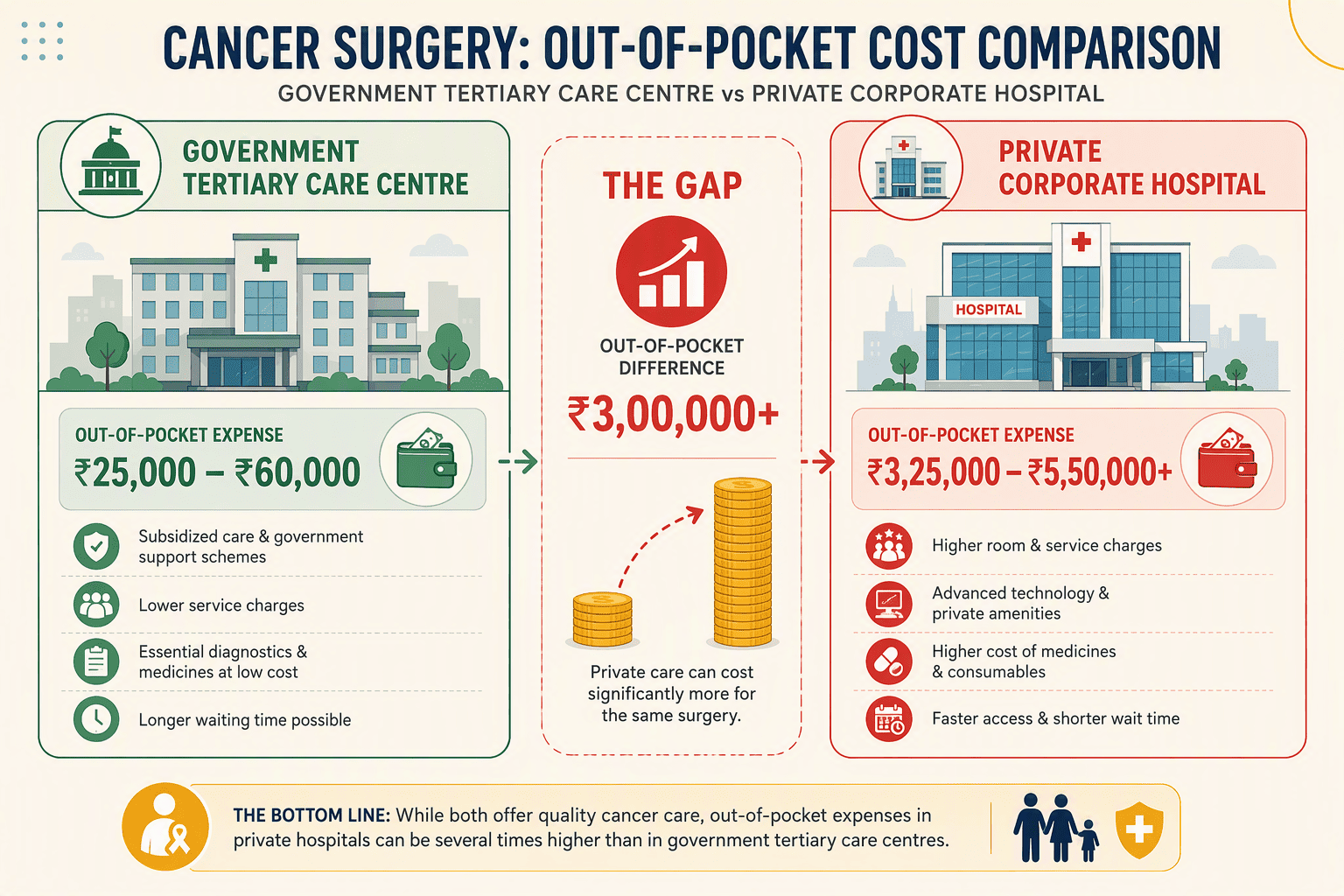
The price delta between a government-run tertiary care centre and a private corporate hospital is not a matter of a few line items; it is a systemic chasm. The *Frontiers in Public Health* study, which sampled 12,148 cancer patients across seven centres in India, pegged the mean out-of-pocket expenditure per hospitalization at ₹39,085. However, this is a blended average. A patient who walks into AIIMS or Tata Memorial Hospital pays a fraction of this amount for the surgery itself, as the government absorbs the massive capital and salary costs that define a private facility's invoice.
These private facility invoices are built on full-cost recovery. The same surgery in a private hospital unbundles every OT consumable, every surgical instrument, and layers a significant professional fee for the surgeon and anaesthetist on top, with no subsidy buffer. The result is a bill that can soar several times higher.
The Anatomy of a Private Hospital Bill: What You're Really Paying For
To understand the private hospital bill is to understand that the surgery itself is only one part of a very long receipt. The deepest cuts come from the supporting services.
- Medicine costs: claim 45% of a patient's out-of-pocket expenditure during hospitalization. A cancer treatment protocol involving chemotherapy drugs, targeted therapy agents, and post-operative biologics can be a greater financial adversary than the surgeon's scalpel.
- Hospital charges: followed closely by the hospital's room rent, operation theatre charges, and the surgeon's professional fee.
- Diagnostics: for outpatient consultations, which set the pre-operative stage, diagnostics alone consume 36.4% of every rupee spent out of pocket. Advanced imaging scans, blood panels, and pre-operative tests are unbundled and charged at a significant markup. A patient effectively pays a premium for the speed and convenience of an in-house lab machine that a private hospital needs to finance against a limited number of daily patients.
Technology’s Double-Edged Sword: How Robotics and Advanced Scans Inflate Surgery Costs
The shiny promise of a robotic-assisted or 'scarless' surgery is a powerful magnet for a vulnerable patient, but behind every da Vinci system sits a brutal economic truth. The capital expenditure is massive, and hospitals recover this investment by attaching a substantial 'technology fee' to every procedure. Here is the actual cost hierarchy that defines a modern surgical bill:
- The Capital Machine: A single robotic surgery program demands an equipment investment that can exceed $5 million. This does not count the annual maintenance contracts, which themselves run into tens of lakhs.
- Per-Procedure Instruments: The arms and cutting instruments on a robotic system are not permanent. They are sealed, sterile disposables with a finite lifespan, creating a mandatory consumable cost of thousands of rupees that is billed directly for every single operation.
- The PET-CT Premium: In diagnostic imaging, a hospital’s ability to offer a PET-CT is a differentiator, but it comes at a heavy cost. An on-site PET-CT means a capital outlay for the machine and a shielded room, plus the recurring cost of the radioactive tracer. The bill to the patient is, therefore, several multiples of a conventional CT scan, and unlike a CT, the hospital promotes it as key for precise cancer staging or restaging.
The Hidden Expenses: Diagnostic Loops and the Cost of Uncoordinated Care
The most maddening part of a hospital bill often isn't the surgery. It is the pile of tests you already paid for once but must pay for again because the new facility refuses to trust the old one's paperwork.
A fragmented care pathway builds a 'diagnostic loop', a costly recycling of scans, pathology slides, and blood work that happens before the surgeon even picks up a scalpel. No one intends to waste money. It is what happens when systems cannot talk to each other.
The table below maps out where the money vanishes. The two most expensive repeats are imaging and pathology.
| Feature | Coordinated Care Model | Fragmented Care Reality |
|---|---|---|
| Imaging Workflow | Patient's prior scans are digitized and accepted; only missing or contrast-specific scans are repeated. | Scans from an unaffiliated lab are rejected as 'unverifiable,' triggering a full redo of MRI and PET-CT on admission. |
| Pathology Review | A single thorough pre-op biopsy review is conducted and integrated into the surgical plan. | A referring physician's biopsy is repeated by the in-house hospital pathologist as a mandatory pre-surgical protocol, duplicating the diagnostic cost. |
| Pre-Anesthetic Work | Blood panels and cardiac clearance done within a defined 7-day pre-op window are accepted by the anaesthesia team. | The same standard set of pre-op labs (CBC, coagulation, metabolic panel) is conducted again by the hospital the day before surgery, duplicating the cost. |
| The Billing Outcome | A linear, predictable pre-operative cost stream. | A costly 'diagnostic loop' where outpatient expenses for repeat tests silently drive up costs before surgery even begins. |
When a CT scan from a neighbourhood lab is rejected at admission, you pay for the scan twice and lose the window your oncologist had mapped out. That loop is a pure administrative tax on being sick.
A Global Benchmark: How Indian Private Hospital Rates Compare to Singapore's MOH Fee Guidelines
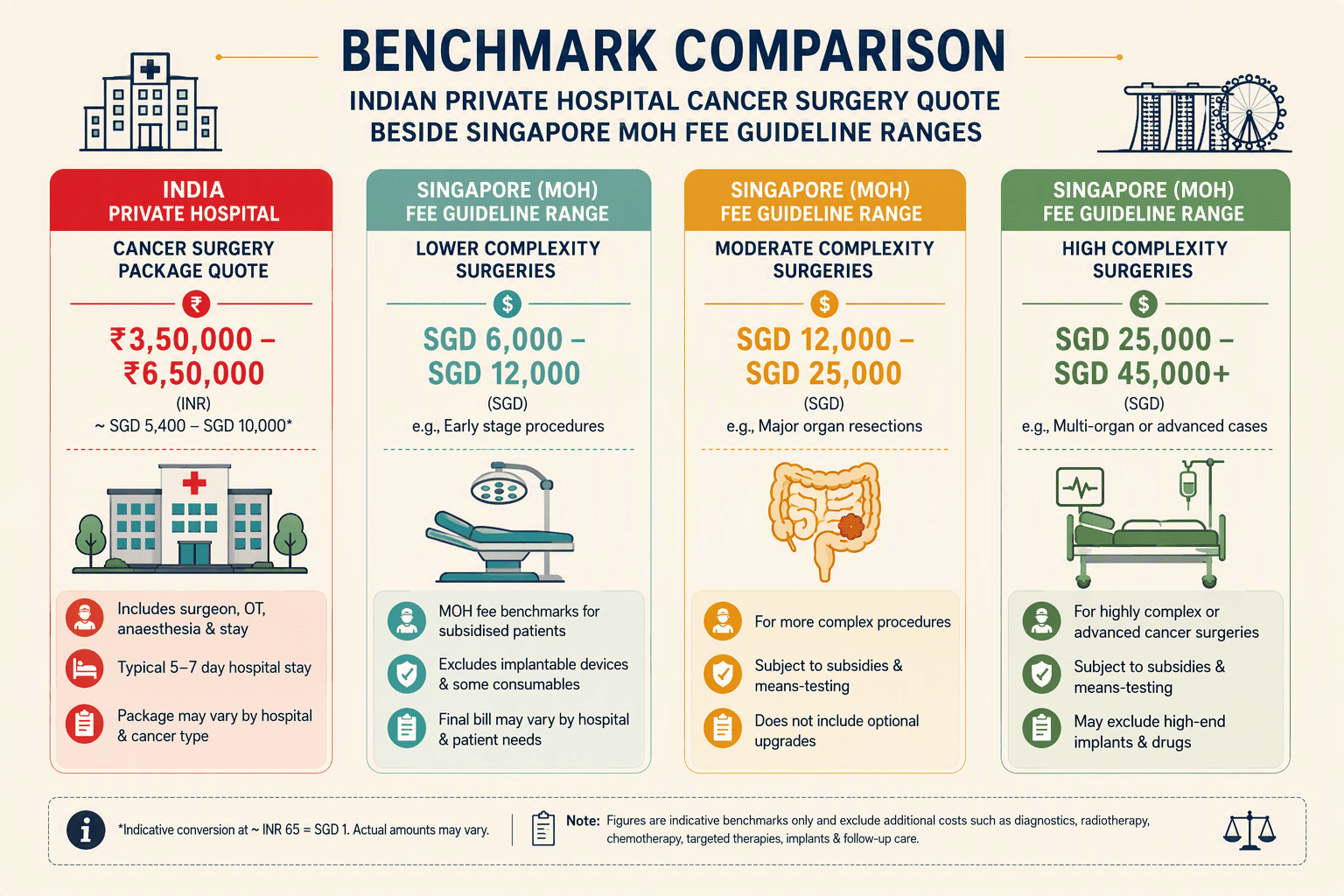
To judge whether an Indian private hospital's quote is reasonable, it helps to have an external, transparent yardstick. Singapore's Ministry of Health provides an ideal one by publishing clear fee benchmarks. These figures act as a cap on what a rational market deems appropriate, giving you a powerful lens to look at your own estimate.
A typical private hospital bill for a major cancer surgery in an Indian metro can rival, and sometimes exceed, a standard surgical package fee in Singapore. Yet the Singaporean benchmark is built on a different foundation: it reflects clean surgical episodes with itemized surgeon and anaesthetist sub-limits.
This international comparison exposes the opacity of Indian hospital billing. For a patient in Haryana, Delhi NCR, or Uttar Pradesh, a centre like Andromeda Cancer Hospital becomes a relevant test case. When a hospital says it has an accessible pricing model and performs advanced surgeries, the Singapore benchmark provides the objective standard to test that claim. Asking an Indian provider how their all-inclusive surgery package for a specific procedure code aligns with or deviates from such benchmarks forces the conversation from abstract empathy to concrete justification.
Your Financial Shield: A Practical Guide to Insurance, Cashless Claims, and Planning
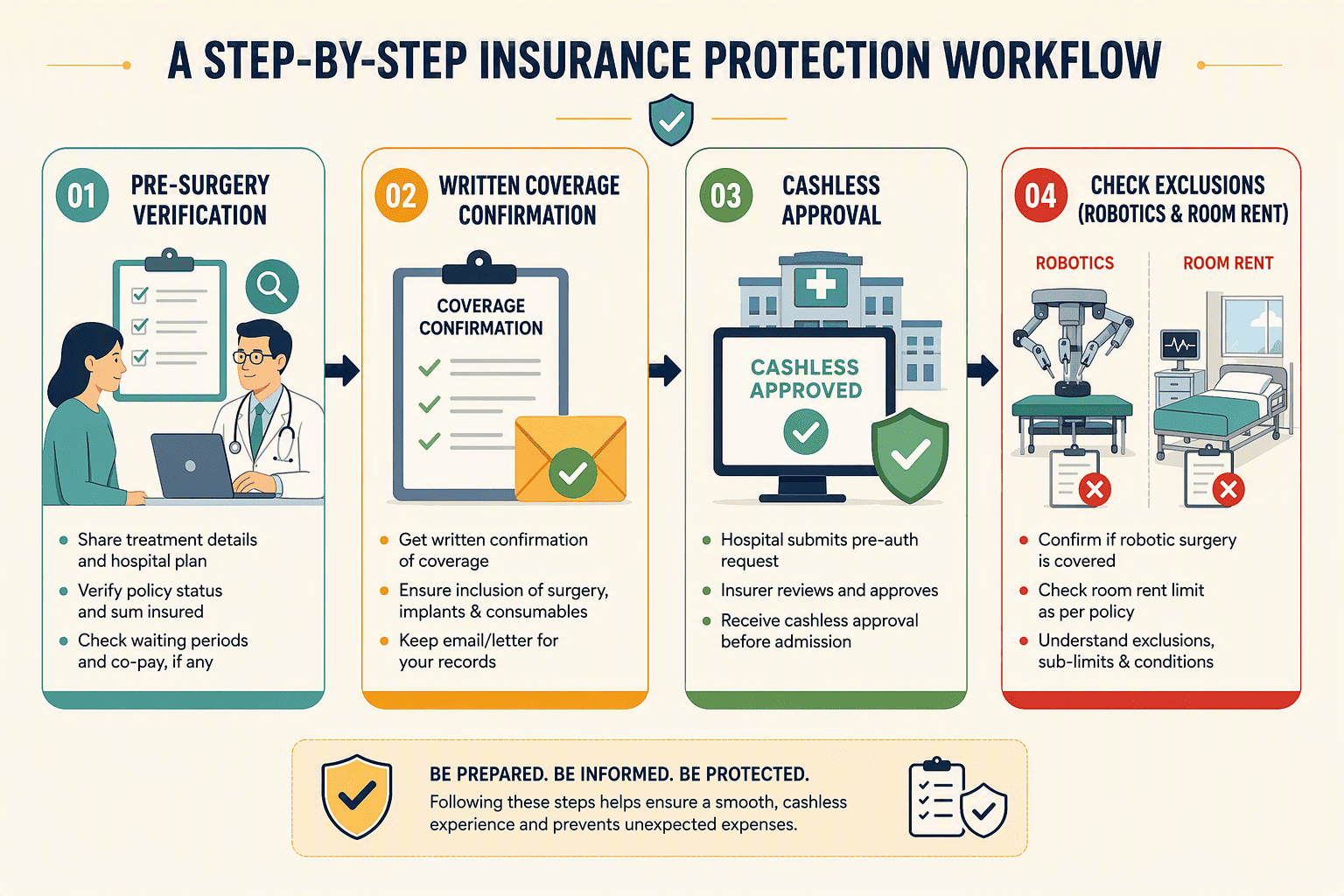
Your primary weapon against financial ruin is the cashless claim, but its efficacy depends on rigorous verification before you consent to surgery. Follow these steps to protect yourself:
- Verify cashless coverage: before the surgery, call your insurer and list every technology the surgeon plans to use, then get specific coverage confirmation in writing. A policy might cover 'cancer treatment,' but the fine print often excludes robotic surgery consumables or caps the room rent. Do not leave this step to the hospital's insurance desk.
- Check Ayushman Bharat eligibility: this government program covers cashless treatment for 1,961 procedures across 27 specialties, including Surgical and Medical Oncology. Verify that your chosen private hospital is empanelled and has no internal cap on the category of cancer surgery you need.
- Ask for generics: when a high-cost biologic or medicine is prescribed, ask your doctor one simple question the CDC also recommends: 'Can I use a generic version?'
- Negotiate a payment plan: speak plainly to the hospital's billing department. Even large private hospitals frequently have internal patient support foundations or structured instalment plans that are never openly advertised but can bridge the gap between your insurance cover and the final bill. The worst outcome comes from silent agreement; the best comes from a transparent negotiation armed with the price comparisons and benchmarks you have gathered.
Conclusion
High cancer surgery costs in India are driven by information asymmetry, not just the disease itself. Fragmented diagnostic loops and opaque technology markups sell hope at a price that shatters families.
Ground every decision in hard data. A single benchmark, the ₹331,177 OOPE figure, gives you a line in the sand. Challenge redundant tests. Price your procedure against published international standards, not the hospital's first quote.
This shifts the power dynamic before the first incision. The cure for the cost crisis is not a new insurance product. It is cold, hard billing literacy applied at every step.
Frequently Asked Questions
Why do private hospitals in India charge significantly more for cancer surgery compared to government hospitals?
Private hospitals operate on a full cost-recovery model with no government subsidy. They must recover the massive capital cost of surgical equipment, infrastructure, and high professional fees from patient bills, whereas government institutions like AIIMS are taxpayer-funded and offer heavily subsidized surgical care.
What specific cost components drive up the final bill for cancer surgery in a private facility?
The bill is dominated by medicine costs, which account for 45% of hospitalization expenditure, and high surgeon and anaesthetist fees. Operation theatre charges and marked-up consumables, such as robotic surgery instruments and specialized implants, add significant layers to the invoice beyond the core surgery cost.
How does the cost of cancer surgery at a private hospital compare to leading centres like AIIMS or Tata Memorial?
The cost delta is a difference of multiples, not percentages. While a private hospital unbundles every OT consumable and surgical instrument at a mark-up, government centres absorb these costs through state funding, meaning a patient at AIIMS may pay a minimal fraction for an identical procedure.
How can I use an international benchmark to see if my private hospital's cost is reasonable?
Use the transparent fee benchmarks published by Singapore’s Ministry of Health, which provide surgeon and anaesthetist sub-limits for procedure codes. Presenting a clean international benchmark to your hospital forces a direct conversation about why your local itemized quote deviates from or aligns with such transparent pricing.
What role do advanced technologies like robotic surgery and PET-CT scans play in increasing cancer care costs?
These technologies create a significant capital burden, as a robotic system can cost over $5 million in equipment alone. Hospitals pass on this cost through high procedure 'technology fees' and mandatory, non-reusable per-procedure disposables, while a PET-CT scan's radiotracer and machine cost make it several multiples of a conventional CT.
What practical steps can I take to verify my insurance benefits and manage the cost of cancer surgery?
To protect yourself financially, take these concrete actions:
- Confirm cashless coverage directly: call your insurer before admission and confirm cashless coverage for every specific technology planned, like robotics.
- Investigate PM-JAY eligibility: check if you qualify for the Ayushman Bharat scheme.
- Ask about generics: ask your doctor about generic medicine alternatives.
- Negotiate a structured payment plan: directly negotiate a structured payment plan with the hospital's billing department.
Sources
- Financial toxicity of cancer treatment in India: towards closing the cancer care gap - PubMed - pubmed.ncbi.nlm.nih.gov
- Table 24, Hospital Budget Impact of Robotic Surgery Program, by ... - www.ncbi.nlm.nih.gov
- Press Release Page | Press Information Bureau - www.pib.gov.in
- Paying for Cancer Treatment | Cancer Survivors | CDC - www.cdc.gov
- Bills and fee benchmarks - Singapore - Ministry of Health - www.moh.gov.sg