

Introduction
A slight change in urine flow or an extra trip to the bathroom at night rarely triggers a crisis alarm. It is too easy to dismiss this as a normal part of ageing. The reality is simple: these subtle flags are exactly how prostate cancer slips past an initial clinical net. The disease already affects approximately 1.4 million new men yearly with 375,000 deaths, and delays in diagnosis are common, driven by both patients dismissing symptoms and systemic logistical bottlenecks.
The cost of waiting is stark. While localized prostate cancer has a near-100% five-year survival rate, the outlook collapses to just 30% for patients who present with distant disease. This widening gap is not just biological; it is a timeline failure. Delayed diagnosis of prostate cancer leads to more advanced stages at presentation and increased mortality. The path to a cure is paved by shaving days off a process riddled with administrative hurdles and psychological blind spots.
This article maps the precise points where the diagnostic clock stops and offers a data-backed route to restart it. We will walk through the clinical misinterpretations, the hidden bottlenecks, and the precise imaging technology capable of accelerating you from ambiguity to a definitive care plan.
Key Takeaways
A swift diagnosis requires tackling both clinical confusion and systemic gridlock. The core findings are summarized below:
- Imaging superiority: PSMA PET-CT is 27% more accurate than conventional CT and bone scans in detecting metastases, offering a single-scan definitive staging.
- Systemic reality: The most common delays are not medical mysteries but logistical logjams: additional work-ups after a biopsy, specialist referral queues, and psychological avoidance.
- Team efficiency: An integrated multidisciplinary care model eliminates handoff gaps, establishing a unified treatment plan immediately rather than through fragmented serial referrals.
- Window adherence: Following evidence-based published timing windows for starting radiotherapy or surgery is a directly controllable factor that prevents the drift from curable to advanced disease.
- Psychological care: Patient navigation and psycho-social support directly counter the fear-driven denial and anxiety that silently elongate the diagnostic journey.
Step 1: Understand the Vague Symptom Onset That Clouds Early Recognition
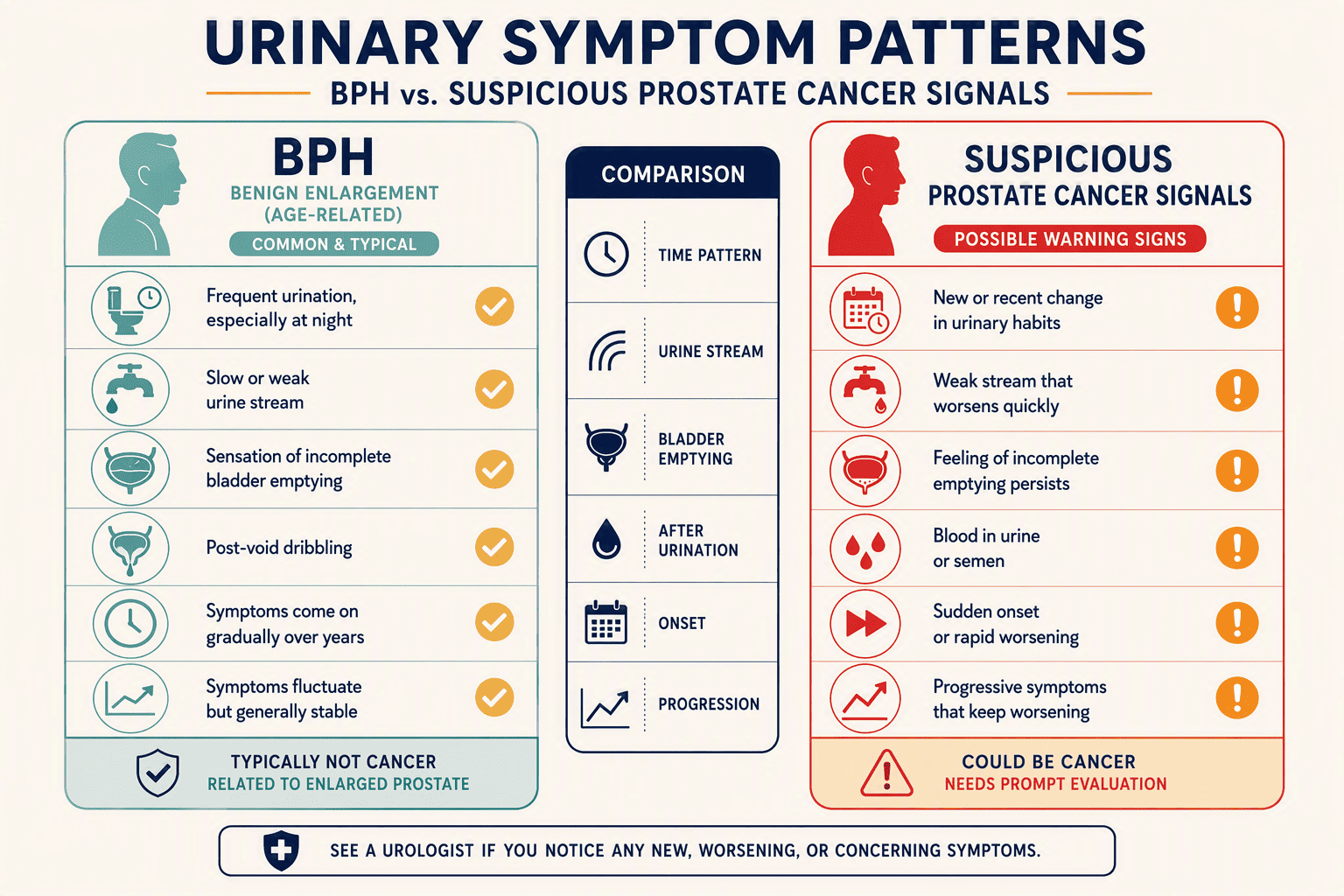
The most dangerous prostate cancer symptom is the one that looks like something else. Without the right context, the clinical line between benign ageing and malignancy disappears. The table below lays out where the signals overlap and where they separate.
| Feature | Benign Prostatic Hyperplasia (BPH) | Potential Malignant Signal |
|---|---|---|
| Sensation | Dribbling, weak stream, and difficulty starting | Storage-only symptoms or purely irritative patterns (urgency/frequency) |
| Onset Speed | Gradual worsening over many years | Symptoms that develop very rapidly |
| Night Patterns | Waking once or twice, slow progression | Persistent nocturia coupled with a sensation of incomplete bladder emptying |
| Pain/Swelling | Usually absent unless infection develops | Pain in the hips, back, or chest can indicate metastasis; unexplained weight loss |
| PSA Trajectory | Stable or slow linear rise | Sustained rapid rise or high levels that persist even after a trial of BPH medication for six weeks |
| Physical Exam | Symmetrical, non-nodular enlargement | Asymmetric nodules or indurated areas on digital rectal exam, though DREs are performed less often now |
Step 2: Pinpoint the Logistical and Systemic Bottlenecks That Delay Diagnosis
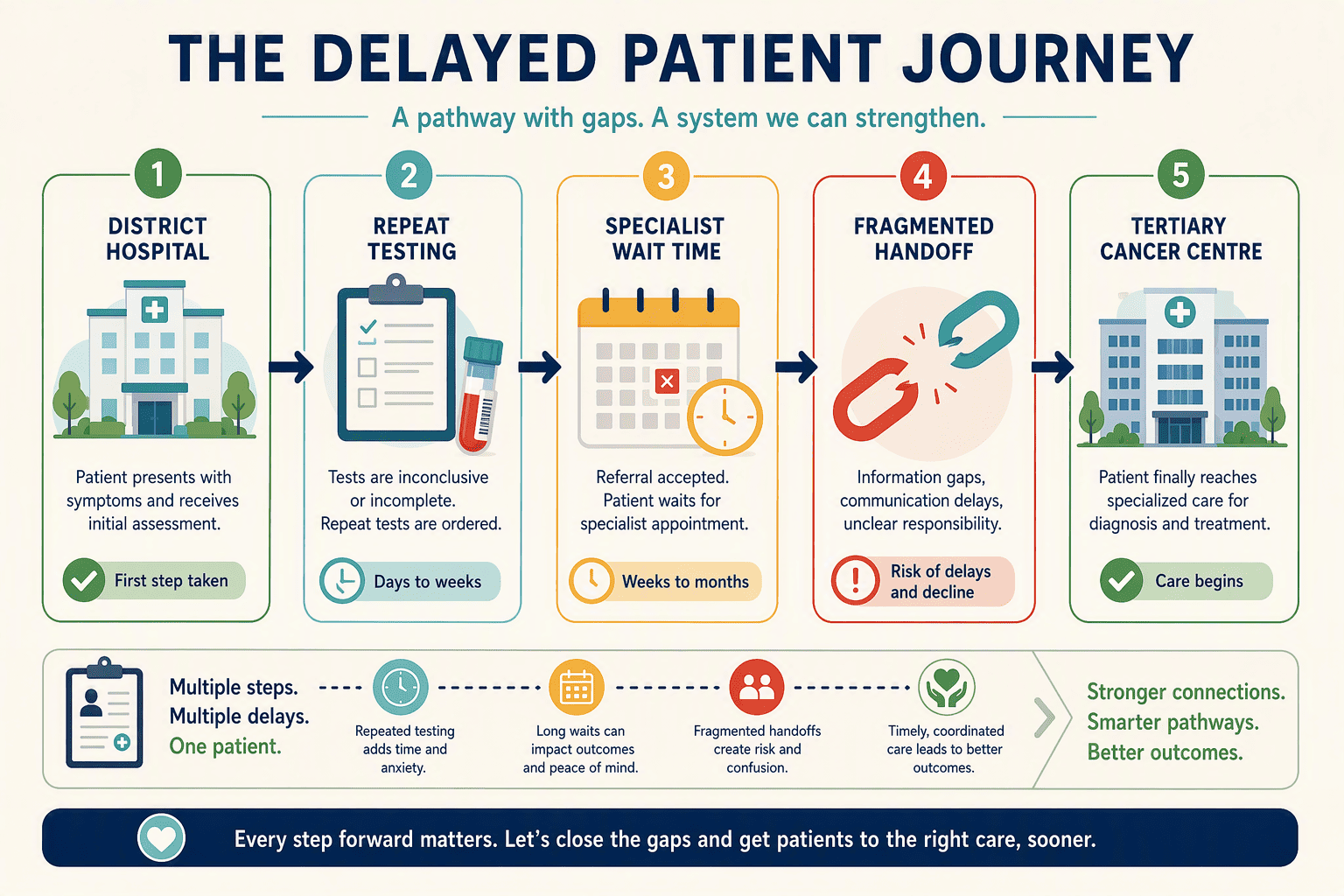
A raised PSA or a suspicious scan is only the starting line. For many men in India, the real delay begins after that first abnormal result. The pathway from a district hospital to a tertiary cancer centre is littered with friction: fragmented referrals, repeat testing, and opaque scheduling. The most common causes of delay are not clinical uncertainty. They are the logistics of additional work-up after an initial prostate biopsy, specialist referral wait times, and poor coordination between departments.
You need to map this pathway coldly before you can fix it. A patient who gets a biopsy in a standalone diagnostic lab often lands back at a urologist's clinic two weeks later holding a report but with no imaging correlation and no next-step plan. The system stalls because no single entity owns the transition from diagnosis to staging. At this juncture, losing even three to four weeks while waiting for a multi-specialty appointment can allow aggressive pathology to consolidate. A narrative review of treatment delays confirms that these logistical choke points are directly linked to worsened oncologic outcomes.
Intercept this drift by consolidating the work-up inside a single institution where the diagnostic loop closes rapidly. A facility that coordinates digital PET-CT and immunohistochemistry (IHC) testing with a turnaround within one week for tumor board review cuts out the most common sources of systemic lag. When you compress the interval between suspicion and a documented treatment plan, you are not just saving time. You are preserving treatment options that vanish once the disease breaches the capsule or metastasizes.
Step 3: Use High-Sensitivity Imaging for Accurate, One-Visit Staging
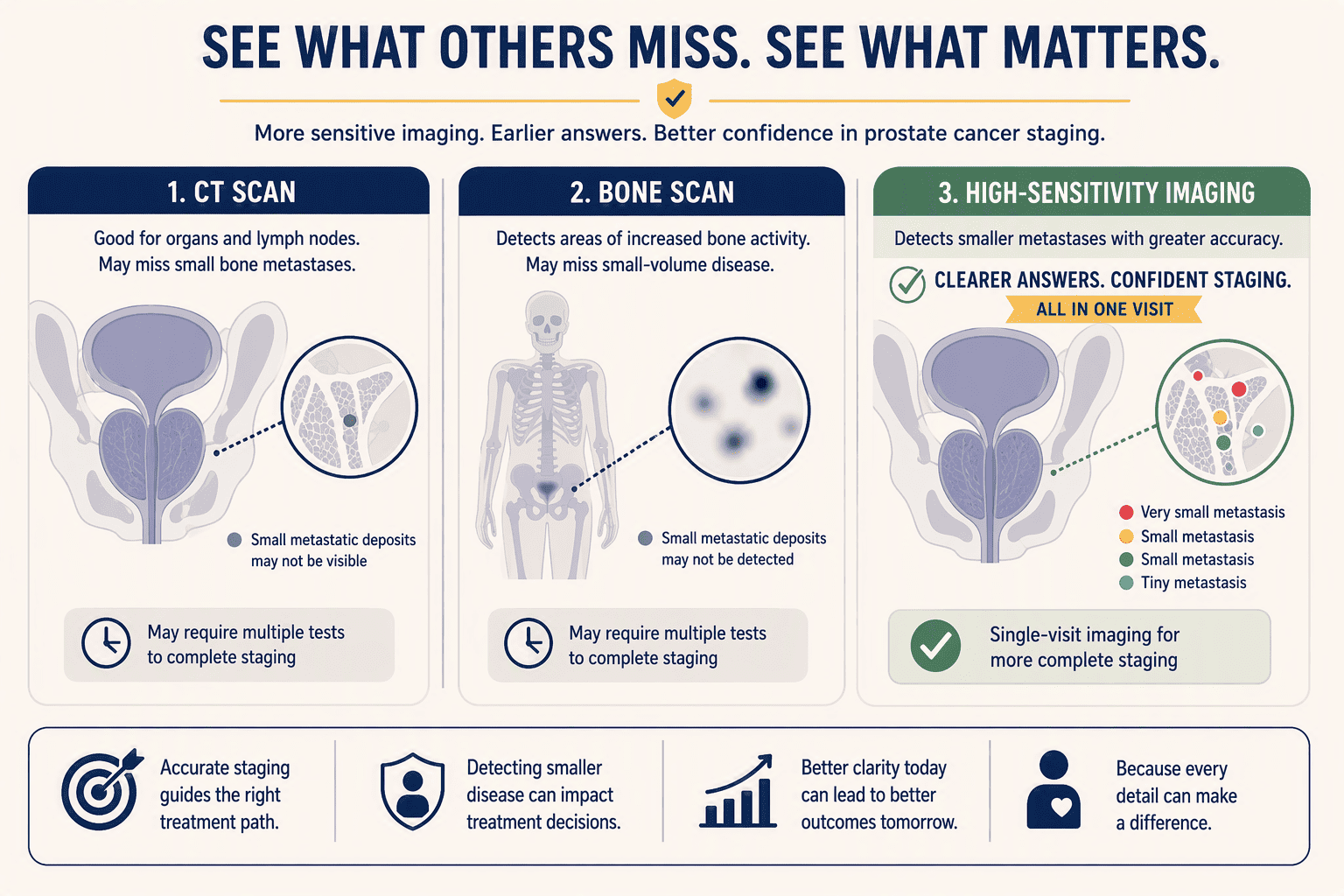
Conventional staging with a CT scan and a bone scan misses small-volume metastatic deposits with alarming regularity. Neither modality is particularly good at finding individual prostate cancer cells, which means very small tumors can slip through undetected. Bone scans also carry a high false-positive risk, picking up non-cancer abnormalities like arthritis and leading you down a diagnostic detour. For men with high-risk localized disease in India, starting with standard imaging alone can write a false story of organ-confined disease.
PSMA PET-CT rewrites that story in a single session. In a landmark Australian trial, PSMA PET-CT was27% more accurate than the standard approach at detecting any metastases, delivering 92% accuracy versus 65% for CT and bone scan. The tracer binds specifically to the PSMA protein, which is expressed in large amounts on prostate cancer cells and increases with worsening tumor grade. This molecular precision translates into clinical clarity. A systematic review demonstrated that staging with PSMA PET-CT alters the planned management in 28% of primary cases and a striking 54% of recurrent cases.
For you, this degree of accuracy changes the entire calculus. If the scan lights up in bone or distant nodes, a radical prostatectomy is no longer the answer; systemic therapy takes precedence. Do not settle for a staging study that guesses. Seek out centres offering digital TOF imaging for cancer staging and recurrence surveillance, where a same-roof PET-CT can shift you from a generic protocol to a tailored strategy within a single working week.
Step 4: Accelerate Care with an Integrated Multidisciplinary Model

In most Indian hospitals, the urologist, radiation oncologist, and medical oncologist work in separate wings, on separate schedules, and write into three separate files. You end up carrying your own reports from one consultation to the next, and no single doctor holds the full picture. The delay is not a scheduling hiccup. It changes your treatment before anyone writes a prescription, because each specialist is optimizing a single modality without a shared read of your pathology, imaging, and overall fitness.
You stop that drift by running your case through an integrated tumor board right from the first workup. Choose programmes that convene multidisciplinary meetings at least twice a week. The surgical, radiation, and medical oncology teams sit together with your histopathology slides and imaging studies in the same session.
When one hospital processes your biopsy in its own histopathology lab, runs the PSMA scan on its own PET-CT, and brings all three oncology streams to the same table at the same time, the calendar shrinks. Decisions that routinely stretch across a month of sequential outpatient visits get made in days. This model earns its keep most visibly in medical oncology, where systemic therapy has to be timed across neoadjuvant, adjuvant, and palliative settings.
If you present with high-grade disease, a coordinated team can settle the sequence immediately, whether that means neoadjuvant chemotherapy before surgery or moving straight to radical local therapy. In urological cancers, organ-confined and metastatic states pull the treatment plan in opposite directions. Multidisciplinary planning is the structural fix for that, not an add-on.
Step 5: Mitigate Psychological Hurdles Through Concurrent Support

A man who fears incontinence, impotence, or the label of cancer more than the disease itself will unconsciously manufacture delays. He will schedule the MRI and then cancel it. He will collect the PSA report but not open it for ten days.
This is not rare. Psychological reasons are documented alongside logistical bottlenecks as a leading cause of delayed definitive management in prostate cancer. The dread of treatment side effects, combined with the minimisation of early urinary symptoms as normal ageing, forms a self-reinforcing loop that stalls action.
Break that loop early by making psychological support concurrent with the diagnostic work-up, not an afterthought offered post-surgery. If you are asymptomatic but carrying a rising PSA, a single education session with a uro-oncology nurse can dismantle the misconception that surgery always equals lifelong incontinence. If you have lower urinary tract symptoms such as frequency, urgency, or nocturia, a clinician must explain clearly that these are often caused by benign prostatic hyperplasia, but a rapid escalation in storage symptoms is a red flag that demands an MRI of the prostate, not a wait-and-watch approach.
Integrated pain management and palliative care also play a counterintuitive role here. When a centre offers anesthesia for minor biopsies and port insertions as structured day-care procedures, it lowers the experiential barrier for men who associate cancer care with suffering.
Knowing that a centre in Sonipat, Delhi NCR provides same-roof supportive interventions from biopsy to survivorship can convert paralysing fear into actionable momentum. Address the mind directly alongside the malignancy, and you close one of the most stubborn gaps in the diagnostic timeline.
Step 6: Adhere to Evidence-Based Timelines to Prevent Treatment Drift
When COVID-19 scrambled hospital schedules, the window for starting prostate cancer treatment became a daily worry. Guidelines on timing existed on paper but offered little biological backing. For men with intermediate- and high-risk disease, that gap created a practical question: at what point does waiting tip from careful planning into avoidable harm?
A review of prospective and retrospective studies points in one direction. Delays that stretch past a reasonable window correlate with worse pathologic findings and higher rates of biochemical recurrence. The clock matters.
Prostate cancer is the most commonly occurring cancer in men worldwide, with approximately 1.4 million new cases and 375,000 deaths each year. For localized disease, the 5-year survival rate in the US sits near 100%. Once the cancer reaches distant sites, that number falls to roughly 30%. The gap between those two outcomes is measured in months, not years. If your PSA is rising and a biopsy confirms Gleason 4+3 or higher, a 12-week delay while you chase second opinions from disconnected specialists carries a real oncologic cost.
Keep the timeline simple. From the date of a high-risk biopsy to the start of definitive therapy, aim for six to eight weeks. Use that interval for precision staging with digital PET-CT, a single thorough tumor board review, and prehabilitation.
Do not fill it with passive waiting. If systemic barriers push you past ten weeks, escalate. A cancer hospital that houses PET-CT, histopathology, and a twice-weekly tumor board under one roof can execute this timeline without the administrative friction that erodes outcomes elsewhere.
Conclusion
Prostate cancer delayed diagnosis is a series of addressable hurdles, not a personal failing. The journey from vague urinary symptoms to definitive care is lengthened by misattribution, administrative dead space, and fear, but it is shortened by precise imaging and integrated teams. The proPSMA trial’s finding that PSMA PET-CT achieves a sensitivity of 71% and a specificity of 92% underscores that we now possess the tools to see the disease quickly and clearly. The remaining task is to use them. For men facing an ambiguous rising PSA or persistent symptoms, the single most effective acceleration is to step into a coordinated model where imaging, consultation, and a treatment plan exist under one roof, converting delay into deliberate action.
Frequently Asked Questions
What are the primary reasons behind delayed diagnosis of prostate cancer in India?
Delays in India stem from two categories: patient-related factors like dismissing urinary symptoms as normal ageing, and system-related factors including fragmented post-biopsy work-ups, poor coordination between specialties, and limited access to high-sensitivity imaging like PET-CT.
What symptoms of prostate cancer are often missed by patients and primary care physicians?
Lower urinary tract symptoms such as urinary frequency, urgency, nocturia, and difficulty starting or stopping a stream are often misattributed to benign prostatic hyperplasia. Rapid onset or storage-only symptoms are red flags that require urgent investigation.
How can men reduce the risk of a late-stage prostate cancer diagnosis?
Men can reduce late-stage risk by opting for regular PSA screening, immediately escalating to an MRI and specialized imaging for persistently elevated levels, and seeking a consolidated multidisciplinary consultation to avoid delays from scattered referrals.
What role does PSA testing play and what are the current screening debates?
PSA testing remains the primary biomarker trigger for biopsy. Short-term data suggest it prevents one death per 1000 men screened, but long-term models show a significantly more favorable benefit. Current U.S. guidelines recommend shared decision-making with a physician, balancing overdiagnosis against mortality reduction.
When should a patient seek a multidisciplinary oncology consultation?
A patient should seek a multidisciplinary oncology consultation immediately upon being diagnosed with high-risk localized disease, especially when PSA levels rise after an initial work-up or when significant urinary symptoms persist, to prevent handoff delays.
How has advanced imaging like PET-CT changed the speed and accuracy of prostate cancer diagnosis?
PSMA PET-CT delivers 92% accuracy in detecting metastases, compared to 65% for conventional CT and bone scans. It identifies small cellular deposits earlier, changes the management plan in 28% of primary cases, and collapses multi-step staging into a single definitive imaging visit.
Sources
- Urological Cancers | Andromeda - www.andromedahospital.in
- Delayed definitive management of localized prostate cancer: what do we know? - PubMed - pubmed.ncbi.nlm.nih.gov
- The effect of unusual presentation on delayed diagnosis of prostate cancer: a case series - PMC - pmc.ncbi.nlm.nih.gov
- PSMA PET-CT Accurately Detects Prostate Cancer Spread - NCI - www.cancer.gov
- Symptoms of early-stage prostate cancer - Harvard Health - www.health.harvard.edu
- PSA screening affords men long-term benefits, study finds - UW Medicine | Newsroom - newsroom.uw.edu
- Histopathologically Validated Diagnostic Accuracy of PSMA-PET/CT in the Primary and Secondary Staging of Prostate Cancer and the Impact of PSMA-PET/CT on Clinical Management: A Systematic Review and Meta-analysis - ScienceDirect - www.sciencedirect.com