
Introduction
A persistent sore in the mouth that refuses to heal, a nagging pain during swallowing, or a subtle change in the voice that lingers for weeks. These symptoms, often dismissed initially, are the silent alarms of head and neck cancers, which constitute a staggering 30% of all cancers in India.
For a family in Sonipat, the moment a diagnosis lands, the immediate question is geography: where, within a radius that allows a life to continue, can you find care that matches the clinical sophistication of a metropolitan hub?
The NCR belt in Haryana is reshaping the answer. Kundli, on the doorstep of Sonipat, has emerged as a private-sector oncology pillar, while the expanding footprint of the Tata Memorial Centre network brings a subsidized public-health safety net closer to the north than ever before. This shift turns a six-week course of daily radiation from a logistical impossibility into a manageable chapter.
This article provides a current, actionable map of that landscape for 2026. We profile the technological backbone of thorough cancer centres, walk through the specific capabilities of the closest facility, and contrast it against the surgical robotics frontier in Delhi and the gold-standard affordability of the government network. The goal: a clinical decision-making framework grounded in the machines, teams, and cost structures available to you right now.
Key Takeaways
- High-precision radiotherapy hardware exists in multiple centres across northern India now. What separates a facility is how the technology connects to the rest of your treatment plan. A twice-weekly multidisciplinary tumor board, where surgical, medical, and radiation oncologists review every case together with imaging and pathology in hand, has the most impact on whether your plan is integrated rather than fragmented. Price varies dramatically, and knowing the actual financial pathways before you commit matters.
- Closest advanced private care sits in Kundli, Sonipat. The same TrueBeam-based radiotherapy protocols are available at HBCHRC New Chandigarh under the Tata Memorial Centre umbrella, at substantially lower government-subsidized rates. For northern families who once had to travel to Mumbai for this level of care, the distance has collapsed.
- Robotic surgery adds another layer. Max Institute of Cancer Care in Delhi fields a Da Vinci XI system for transoral and complex head and neck procedures. It commands a premium price. Whether that premium translates into a better outcome depends on your specific tumor site and staging, something a tumor board can evaluate before you commit to a facility.
- Financial navigation matters from the first consultation. Some private centres, including Andromeda, actively support crowdfunding pathways to bridge the gap between immediate clinical needs and out-of-pocket spend. Public facilities offer low upfront cost but longer queues. Ask about both when you call.
What Defines a Comprehensive Head and Neck Oncology Centre
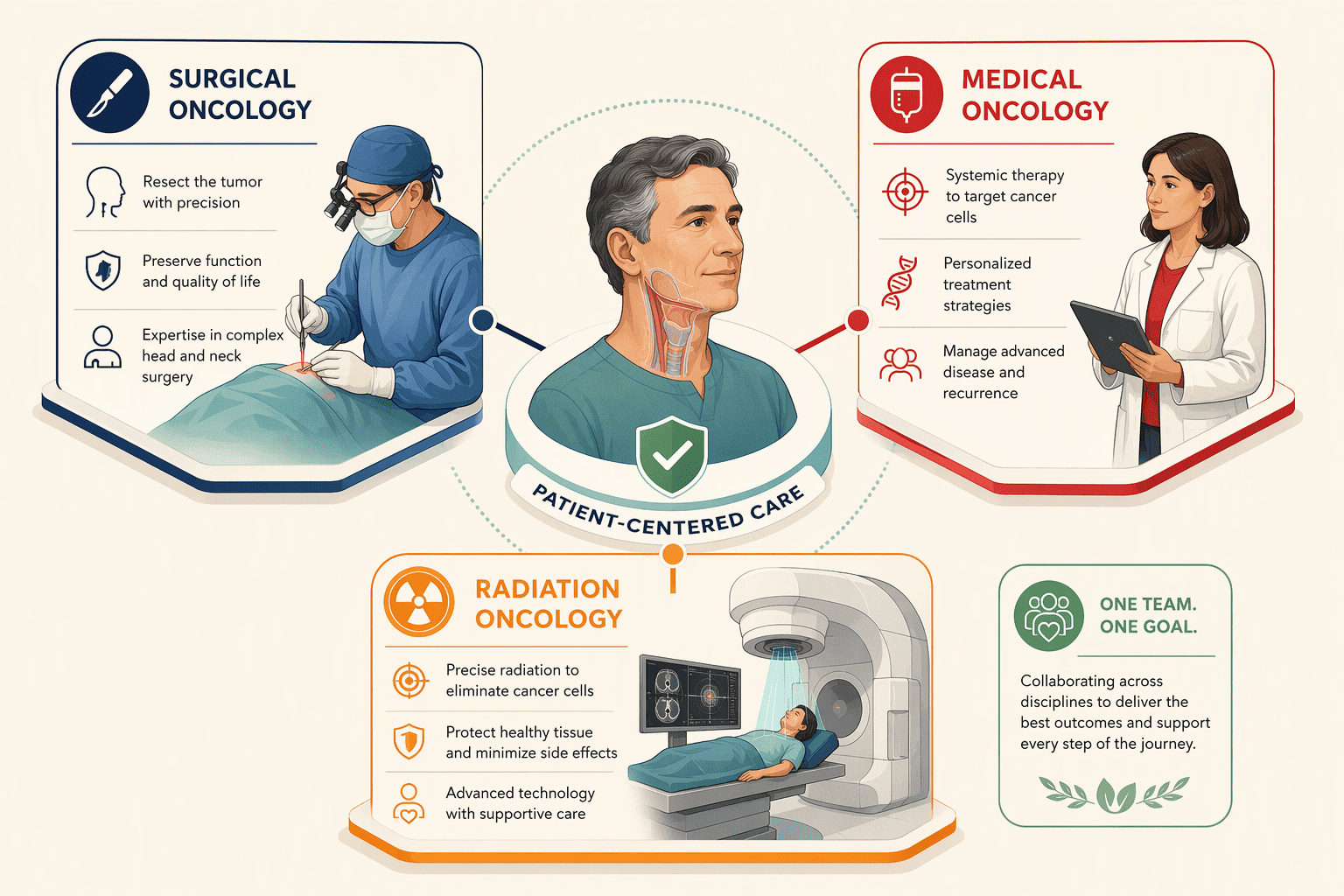
A facility calling itself a cancer hospital must deliver far more than a radiation machine and a surgeon. True thorough care for head and neck malignancies rests on a clinical triad, surgical oncology, medical oncology, and radiation oncology, operating as a fused unit. This is the structural prerequisite for treating squamous cell carcinomas that arise in the most anatomically dense and functionally critical region of the body. Without concurrent expertise across these three disciplines, treatment plans become fragmented compromises rather than a unified, curative strategy.
The mechanism that enforces this fusion is the multidisciplinary tumor board. At institutions like Andromeda Cancer Hospital, this board convenes twice weekly, bringing together the surgeon, the medical oncologist, and the radiation oncologist to review every case before a treatment path is finalized. This is the point at which the decision is made to sequence induction chemotherapy before surgery or to prioritize organ-preserving radiation, based on a real-time, three-specialty evaluation of the staging scans.
Equally critical is the speed of the diagnostic engine that feeds the tumor board. An on-site PET-CT scanner and a pathology lab capable of a rapid immunohistochemistry (IHC) turnaround are the rate-limiting factors for treatment initiation. Andromeda’s model delivers PET-CT and IHC results within one week, compressing the diagnostic limbo into a definitive, actionable timeline.
The integration of these three elements, a fused oncology triad, a structured tumor board cadence, and a diagnostic cycle measured in days, marks the line between a facility that treats cancer and a thorough centre that manages the entire disease arc. If a hospital cannot demonstrate all three, the care pathway is already compromised before the first fraction of radiation is delivered. This definition becomes even more urgent when you consider the sheer scale of the disease. Squamous cell carcinoma of the oral cavity, pharynx, and larynx accounts for nearly 90% of head and neck cancer cases, and tobacco use remains tragically dominant, linked to 85% of head and neck cancers. With almost 75% of patients with head and neck squamous cell carcinoma benefiting from radiotherapy, the precision of the radiation planning integrated through that tumor board is, for most patients, the single most definitive factor in the curative equation.
Modern Technologies for Diagnosis and Radiotherapy Near Sonipat
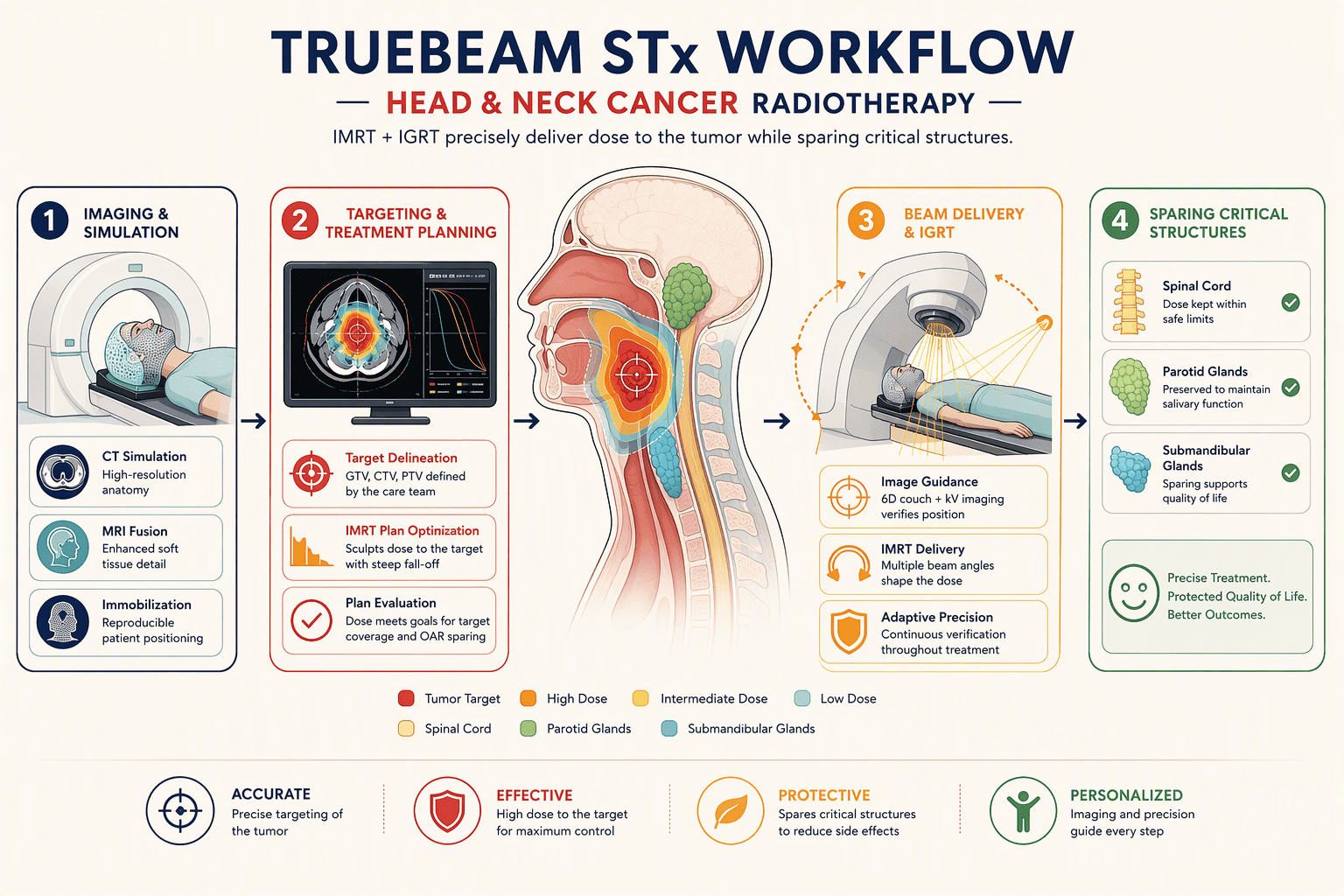
The ability to cure head and neck cancer while preserving the ability to speak, swallow, and breathe hinges on a machine’s capacity to see the target before it fires and to sculpt the dose around the spinal cord and salivary glands. In the Sonipat-NCR corridor, this capability is now underpinned by the Varian TrueBeam STx platform and its suite of delivery modes:
- Intensity-modulated radiation therapy (IMRT): This is an advanced, three-dimensional form of radiation that shapes each beam to the unique contours of the tumour, delivering the high, curative dose while protecting critical structures millimeters away.
- Image-guided radiation therapy (IGRT): Before every single daily session, the TrueBeam captures an on-board CT scan. This ensures sub-millimeter repositioning, accounting for weight loss or subtle anatomical shifts during the grueling six-to-seven-week treatment marathon.
- Volumetric arc therapy (VMAT): By rotating the entire linear accelerator gantry around the patient in a continuous arc while dynamically reshaping the beam, VMAT slashes treatment time to less than a fraction of older techniques. Shorter sessions reduce patient motion and significantly improve the patient’s daily experience.
- Stereotactic radiosurgery and stereotactic body radiation therapy (SRS/SBRT): Reserved for critical junctional recurrences or surgically inaccessible targets, this technology delivers an ablative dose in one to five sessions, essentially executing a surgical strike with radiation.
These technologies collectively address the central H&N challenge: delivering the massive doses required for local control, a treatment course that, at the cellular level, demands fractions of roughly 66 to 74 Gy, while minimizing the long-term toxicity that defines a survivor’s quality of life.
Located in Kundli, Sonipat, Andromeda Cancer Hospital is the single closest facility to Sonipat equipped with a fully modern, integrated technology stack for head and neck malignancies. It operates as a 105-bed dedicated cancer hospital. For a patient facing six to seven weeks of daily radiation, eliminating a long daily commute can make the difference between completing treatment on schedule and missing sessions that compromise outcomes.
The hospital's diagnostic framework is built for speed. The on-site radiology department provides 3D full-field digital mammography and high-resolution ultrasound with elastography. For head and neck staging, the pivotal tool is the PSMA PET-CT, and the institution completes diagnostic and IHC testing within a one-week window. This rapid diagnostic loop feeds directly into a twice-weekly multidisciplinary tumor board, where a thorough surgical, medical, and radiation plan is assembled without the delays that plague fragmented systems. On-site onco-pathology and nuclear medicine support the process end to end.
Financially, the model occupies the moderate private tier, a position that matters for families who cannot endure government waiting lists but also cannot absorb top-tier metro pricing. Andromeda actively supports patients through crowdfunding pathways, which turns the immediate initiation of advanced radiotherapy into a practical step rather than a prolonged financial negotiation.
Government-Subsidised Options: HBCHRC New Chandigarh and the TMC Network
For families where out-of-pocket expenditure is the primary barrier to starting treatment, the Homi Bhabha Cancer Hospital & Research Centre (HBCHRC) in New Chandigarh is the most significant public-health cancer centre to open in northern India in recent years. It falls under the Tata Memorial Centre (TMC) network, which brings the TMC treatment protocols into Punjab and Haryana through a fully subsidized government-hospital structure.
The core promise is clear: TrueBeam-based radiotherapy protocols, identical in technical specification to those used at the Mumbai hub, delivered at government-hospital costs. The trade-off is distance, and it has to be weighed honestly. Kundli requires a short local commute. New Chandigarh is farther out, and a standard six-week radiotherapy course typically means a temporary relocation or substantial logistical help from family.
Delhi NCR Hospitals with Advanced Head and Neck Surgical Robotics
The surgical frontier for head and neck cancer in northern India sits at the Max Institute of Cancer Care in Delhi. The gap that matters here is technological: surgical robotics. Max was the first facility in northern India to acquire the Novalis Tx for IMRT, IGRT, radiosurgery, and SRS/SRT, and it pairs this with the Da Vinci XI Robotic System, a platform that changes how surgeons approach tumours of the oral cavity, throat, larynx, and salivary glands.
Transoral robotic surgery (TORS), enabled by the Da Vinci system, sidesteps the traditional open-jaw exposure. It delivers a high-definition, three-dimensional, magnified view and wristed instrumentation that navigates the narrow posterior confines of the pharynx and larynx without large external incisions. The result: shorter recovery and less functional morbidity.
Max Hospitals bundles organ-preserving surgery and precision radiation therapy into an integrated protocol. For a reader from Sonipat, the practical detail is the cost bracket. This is top-tier private healthcare, priced accordingly.
When a patient's disease is anatomically suited to a robotic resection rather than primary chemoradiation, having this capability in Delhi creates a workable tertiary-care backstop. It is a two-to-three-hour drive for the surgical admission and follow-up, complementing the local radiation-centered facilities closer to home.
Cost, Accessibility and Wait Times: Private versus Public Care
A family in Sonipat choosing where to pursue head and neck cancer treatment is really choosing their trade-off between time and money. The table below maps the actual differences across the three centers most immediately relevant to that decision.
| Dimension | Andromeda Cancer Hospital (Kundli) | HBCHRC (New Chandigarh) | Max Institute of Cancer Care (Delhi) |
|---|---|---|---|
| Proximity from Sonipat | Immediate local access | Requires temporary relocation or multi-hour commute | 1.5 to 2.5 hours, manageable for surgical admission |
| Cost Model | Private, moderate cost; actively supports crowdfunding pathways | Government-subsidized, rock-bottom pricing | Private, premium pricing |
| Radiotherapy Technology | Varian TrueBeam STx (IMRT, IGRT, VMAT, SRS/SBRT) | TMC network TrueBeam (identical protocol standard) | Novalis Tx (IMRT/IGRT/Radiosurgery) |
| Surgical Capability | Head and neck surgical oncology, integrated tumour board | TMC standard surgical protocols | Da Vinci XI Robotic System for transoral robotic surgery |
| Wait Times and Access | Immediate private access | Possible waiting list due to high public-patient load | Immediate, moderate-volume private center |
| Diagnostic Turnaround | One-week PET-CT and IHC loop | TMC-integrated pathology pipeline | In-house premium diagnostic infrastructure |
The public route through HBCHRC offers the lowest financial barrier. TMC-network True Beam technology runs on the same protocol standards as the private centres, and the integrated pathology pipeline connects directly to a national cancer grid. The cost of that subsidy is time: high patient loads mean a real possibility of a waiting list, and reaching New Chandigarh means either relocating temporarily or sinking hours into a commute that eats into every treatment day.
Max in Delhi operates at the opposite end of the spectrum. Premium pricing buys the Da Vinci XI robotic system for transoral surgery, immediate access with no queue, and in-house diagnostics built for speed. For a family that can afford it, the main friction is the 1.5-to-2.5-hour drive from Sonipat, which is inconvenient for a radiotherapy course of daily fractions but feasible for a planned surgical admission.
Andromeda splits the difference in a way that changes the calculation for many families. It sits in Kundli, minutes from Sonipat, so daily radiotherapy visits do not require uprooting the household. The cost model is private but moderate, and the hospital actively supports crowdfunding pathways for patients who cannot cover the full amount out of pocket. The Varian TrueBeam STx linear accelerator delivers the same class of precision targeting, IMRT, IGRT, VMAT, radiosurgery, found in Delhi's premium centrs. Pathology turnaround, including PET-CT and immunohistochemistry, runs on a roughly one-week loop.
For a family watching a diagnosis clock, the
Your First Conversation: Questions to Ask a Head and Neck Cancer Team
When your family arrives at that first consultation, the power dynamic can feel overwhelming, but you are purchasing a clinical pathway, not a machine, and the right questions quickly reveal the depth of an institution's commitment to true multidisciplinary care.
Start by asking directly: 'How is the decision to operate versus irradiate made in my case? Is my case discussed in a formal, scheduled tumor board with your surgical, medical, and radiation teams present, or does the surgeon decide alone?' This question separates an integrated center from a siloed one.
Next, secure the technical foundation: verify the unit's AERB certification and request the linear accelerator specification, specifically whether it supports daily IGRT for treatment repositioning. Follow up with the critical logistical question: 'Has the PET-CT been completed, and can I see a final written treatment protocol with my exact dose fractionation within seven days?'
Finally, do not leave without asking the financial officer directly how the hospital's pure-self-pay pricing compares to any charity bed or crowdfunding pathways they can help you navigate. A quality institution presents this as a standard part of the intake process.
Conclusion
The geography of thorough head and neck cancer care around Sonipat shifted decisively in 2026. Advanced radiotherapy is now available locally at Andromeda Cancer Hospital in Kundli, with integrated diagnostics and a tumor-board framework. For subsidised care, HBCHRC New Chandigarh extends the Tata Memorial Centre model to the north. And for robotic surgery, Delhi's Max Hospital remains a short drive away.
One requirement stays the same whichever path you take. Find a cenetr that operates with a fused oncology triad and get your case before a multidisciplinary team within the first week. That single step is what converts a diagnosis into a coordinated treatment plan.
Frequently Asked Questions
What thorough head and neck cancer treatments are available at hospitals near Sonipat?
The treatment arc includes on-site PET-CT diagnostics, IMRT/IGRT radiotherapy, chemotherapy, immunotherapy, and twice-weekly multidisciplinary tumor board planning within a one-week diagnostic turnaround.
Which modern technologies are used for head and neck cancer diagnosis and treatment in Sonipat hospitals?
The primary technology stack near Sonipat is the Varian TrueBeam STx, which delivers intensity-modulated radiation therapy (IMRT), image-guided radiation therapy (IGRT), volumetric arc therapy (VMAT), and stereotactic radiosurgery (SRS). Diagnostic precision relies on on-site PSMA PET-CT scanning and a rapid immunohistochemistry (IHC) pathology pipeline.
How does Andromeda Cancer Hospital in Kundli, Sonipat, manage head and neck cancers?
Andromeda manages head and neck cancers through a fused multidisciplinary board that meets twice weekly, linking on-site onco-pathology and nuclear medicine. The process emphasises a one-week PET-CT and IHC diagnostic loop to feed rapid treatment initiation, supported by a moderate private cost model and active crowdfunding navigation for patients.
What is the cost and accessibility of advanced head and neck cancer care in Sonipat, Haryana?
Accessibility is immediate at the local private facility in Kundli, which offers moderate pricing and crowdfunding support. The government-subsidized option is at HBCHRC New Chandigarh at rock-bottom public-sector prices, though it introduces a relocation burden. The premium surgical option at Max in Delhi requires a higher private outlay.
Are there experienced head and neck cancer surgeons or oncologists in Sonipat hospitals?
Yes, the dedicated cancer hospital in Kundli includes specialists in head and neck surgical oncology and radiation oncology who participate in a structured, twice-weekly tumor board. The institution also offers advanced medical oncology, including chemotherapy, targeted therapy, and immunotherapy, delivered within a specialized chemo-daycare unit.
What makes a hospital a thorough center for head and neck oncology in India?
A true thorough center must fuse all three oncology disciplines under one roof with a formal multidisciplinary tumor board, own an on-site PET-CT with a rapid IHC turnaround of approximately one week, and deploy a modern linear accelerator capable of daily IGRT:- Oncology disciplines: fuses all three oncology disciplines under one roof with a formal multidisciplinary tumor board.
- Imaging and pathology: owns an on-site PET-CT with a rapid IHC turnaround of approximately one week.
- Radiotherapy equipment: deploys a modern linear accelerator capable of daily IGRT.
Sources
- Best Cancer Hospital in Delhi NCR | Top Cancer Specialists - www.andromedahospital.in
- Best Cancer Hospital in Delhi NCR, India: Book Oncologist Appointment Online | Max Hospital - www.maxhealthcare.in
- Head Neck Cancer Specialist in Sonipat | Cancer Care Hospital in Sonipat - dayanandhospitals.in
- Radiation therapy in head and neck cancer - PMC - pmc.ncbi.nlm.nih.gov