
Introduction
The financial weight of a cancer diagnosis is often the first shock, arriving long before anyone has fully processed the clinical news. In India, a family can burn through savings at an alarming rate, with treatment costs running from ₹5 lakh to over ₹25 lakh. If you are one of the millions holding more than one health insurance policy, you technically have better armor against this financial shock. But a stark gap exists between simply owning multiple policies and actually getting a chemotherapy center to accept both of them without a fight. This guide breaks down a clear, structured process to find and navigate a center that can coordinate your coverage, preventing catastrophic out-of-pocket expenses.
Key Takeaways
Before you begin calling hospitals, understand the non-negotiable facts that will govern your financial safety. These points are your checklist for every conversation with an insurance desk.
- Direct Verification is Non-Negotiable: A hospital's marketing claim of accepting insurance is worthless until you verify network status directly with each insurer for your specific policy.
- Pre-Authorization is the Gatekeeper: Securing a cashless pre-authorization from your primary insurer is the single most critical step before scheduling treatment.
- Coverage is Granular, Not Blanket: Do not assume that 'chemotherapy cover' includes PET-CT scans, molecular pathology, or supportive growth factor injections. Verify each line item separately.
- Layering Policies Closes Gaps: You can use a primary policy for deductibles and room rent, and a secondary or top-up policy to cover the remaining high-cost items like immunotherapy, which can cost ₹1 to 3 lakh per cycle.
- Government Empanelment is a Starting Point: Centers empanelled under Ayushman Bharat PM-JAY provide a floor of ₹5 lakh coverage, but you must still verify if they accept your private supplemental insurance.
- The Billing Desk is Your Ally: Choose a center with a dedicated corporate or insurance liaison desk that has demonstrated experience processing multi-policy claims.
- Documentation Discipline is Mandatory: Reimbursement claims demand original discharge summaries, pharmacy bills with batch numbers, and diagnostic reports. A single missing page can derail a claim.
Step 1: Understand Your Multi-Insurer Coverage and Center Eligibility
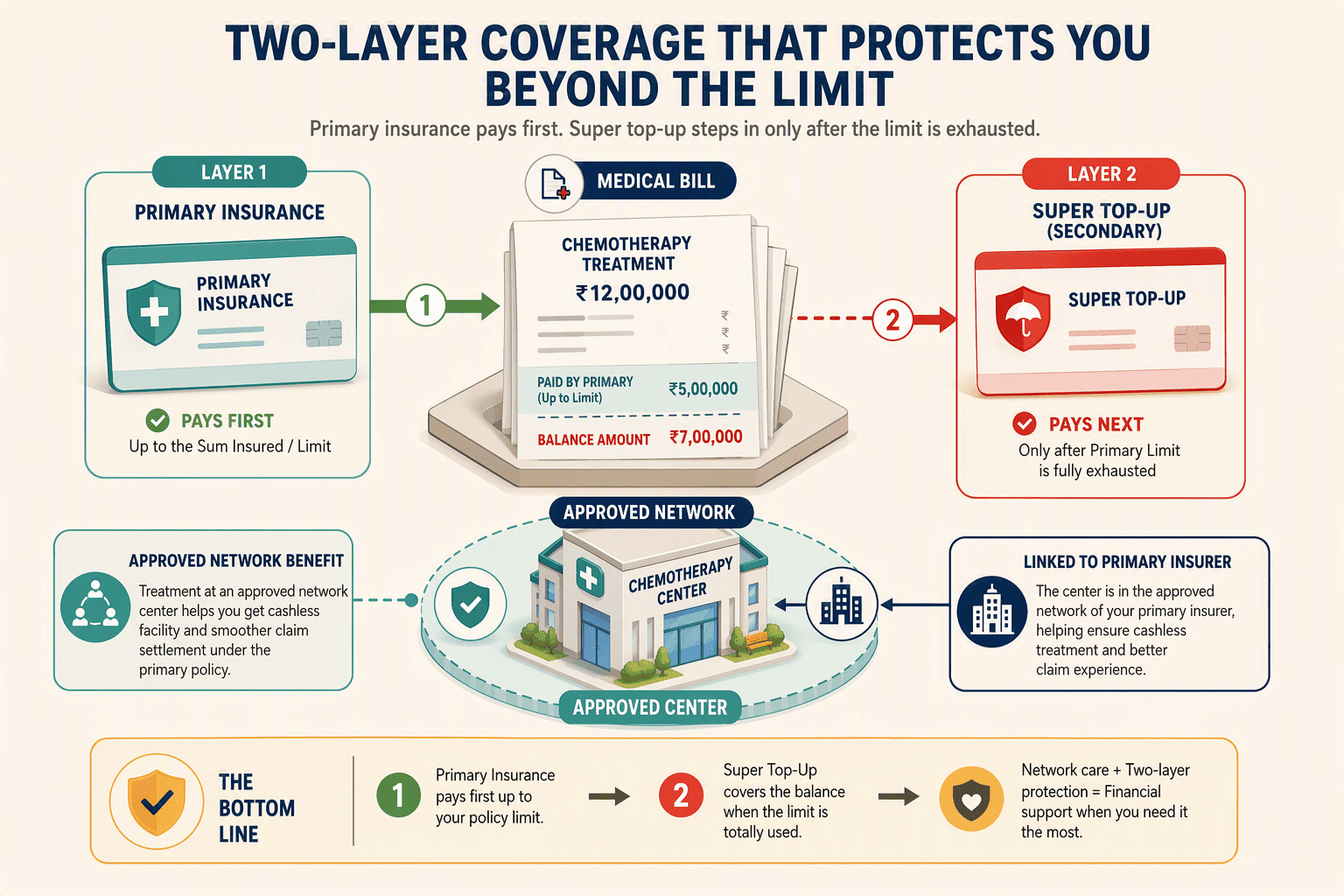
Before you walk into a hospital, know the order in which your insurance policies will pay. The first policy you file against is primary. The second kicks in only after the primary's sum insured or a set deductible is exhausted. A practical setup pairs a base corporate or individual policy as primary with a super top-up plan as secondary, covering the costs that spill past the primary limit.
For a cancer center to be ‘eligible,’ it must sit in the primary insurer’s approved network. Government-empanelled centers under Ayushman Bharat operate separately, offering defined packages up to ₹5 lakh per family for eligible households. The coverage only applies if the hospital is listed on the PMJAY portal.
The table spells out how each layer fits.
| Dimension | Primary Insurance (e.g., Private Policy) | Secondary/Top-Up Insurance | Government-Empanelled Centers (Ayushman Bharat) |
|---|---|---|---|
| Role in Coverage | Pays first, covers up to sum insured | Pays after the primary limit (deductible) is crossed | Covers specific packages up to ₹5 lakh per family |
| Center Requirement | Must be a recognized 'network hospital' for cashless | Generally follows the primary insurer's network rules | Must be an empanelled public or private hospital listed on www.pmjay.gov.in |
| Common Policy Holder | Individuals or employees with group coverage | Individuals seeking additional buffer for high costs | Families eligible under Socio-Economic Caste Census (SECC) criteria |
| Interaction Strategy | Use for room rent, standard chemo, and diagnostics | Activate for immunotherapy, targeted therapy, or transplant costs | Use as a tertiary safety net or if private policies have exclusion periods |
Step 2: Verify Network Status with Specific Indian Insurers
Never delegate this task to the hospital's front desk alone. An error here creates direct personal liability for the entire bill. Insurers like Star Health, ICICI Lombard, and the four public sector giants including New India Assurance maintain frequently updated online provider lists. You must verify your chosen center independently with every single policy you hold. A facility like Andromeda Cancer Hospital, a 105-bed tertiary oncology facility in Sonipat, may maintain partnerships with multiple insurers, but you need written confirmation for your specific policy ID.
- List Every Policy Number: Write down the member ID for your primary corporate or individual plan, any secondary family floater, and government coverage like CGHS or ECHS.
- Access Each Insurer's Portal: Log in to the official website or mobile app for each insurer. Navigate to the 'Hospital Locator' or 'Network Search' function and enter the hospital name and city.
- Download the Current List: Insurance networks change quarterly. A hospital that was in-network during the last quarter might be out-of-network now. Save or print the dated list showing the hospital's name.
- Call the Insurer Helpline: Speak to a claims representative. Ask the direct question: 'Is [Hospital Name] in the cashless network for my policy number [ID] for the specific procedure of chemotherapy?' Note the representative's name and the call reference number.
- Cross-Check with the Hospital TPA Desk: Present the hospital's billing department with your policy details and the confirmation you received. Ask them to confirm that their empanelment is active and not expired. Hospitals have a separate agreement with Third Party Administrators (TPAs), and this back-end link must be live.
Step 3: Decode the Real Cost of Chemotherapy in India
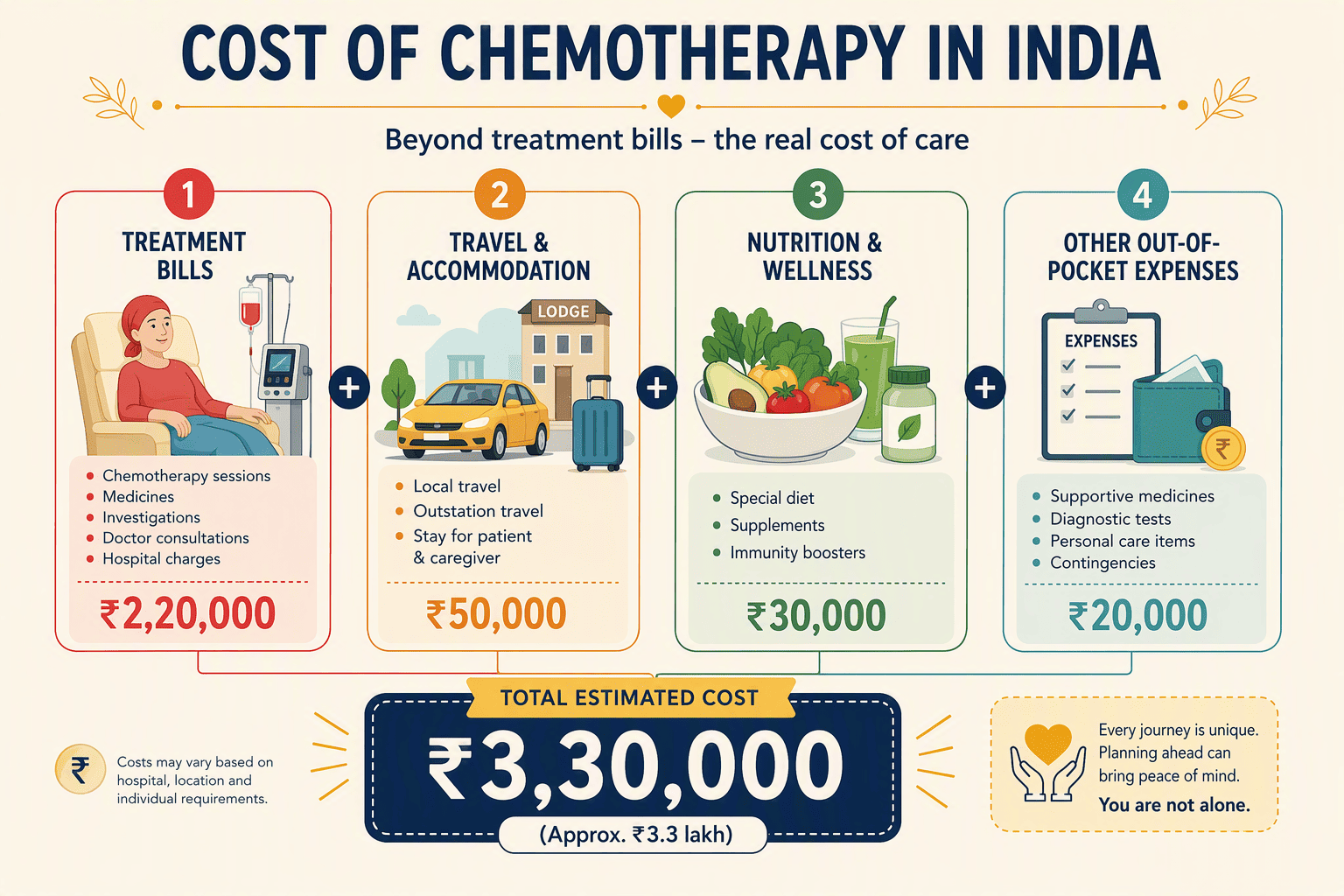
Insurance coverage only makes sense when you know the actual price tags you are facing. General chemotherapy protocols can already push families deep into financial distress, with evidence showing that families may spend around ₹3.3 lakh per year out-of-pocket on cancer care alone. This figure encompasses both medical and non-medical expenses, revealing that even 'covered' patients often bleed money on travel, nutrition, and supportive drugs.
When treatment protocols escalate to advanced therapies, the numbers jump dramatically. The PIB reported on a Tata Memorial Centre study finding that a six-month course of immunotherapy alone costs nearly 80 times the average monthly income. A single cycle of targeted therapy or immunotherapy can range from ₹1 lakh to ₹3 lakh. For hematological cancers requiring a bone marrow transplant, total bills routinely land between ₹10 lakh and ₹40 lakh.
This is where layering becomes key. A basic policy with a ₹10 lakh limit will be consumed entirely by surgery and a few cycles. The secondary policy is not a luxury here; it is the only bridge between treatment and destitution.
Step 4: Confirm Coverage for Specific Procedures and Diagnostics
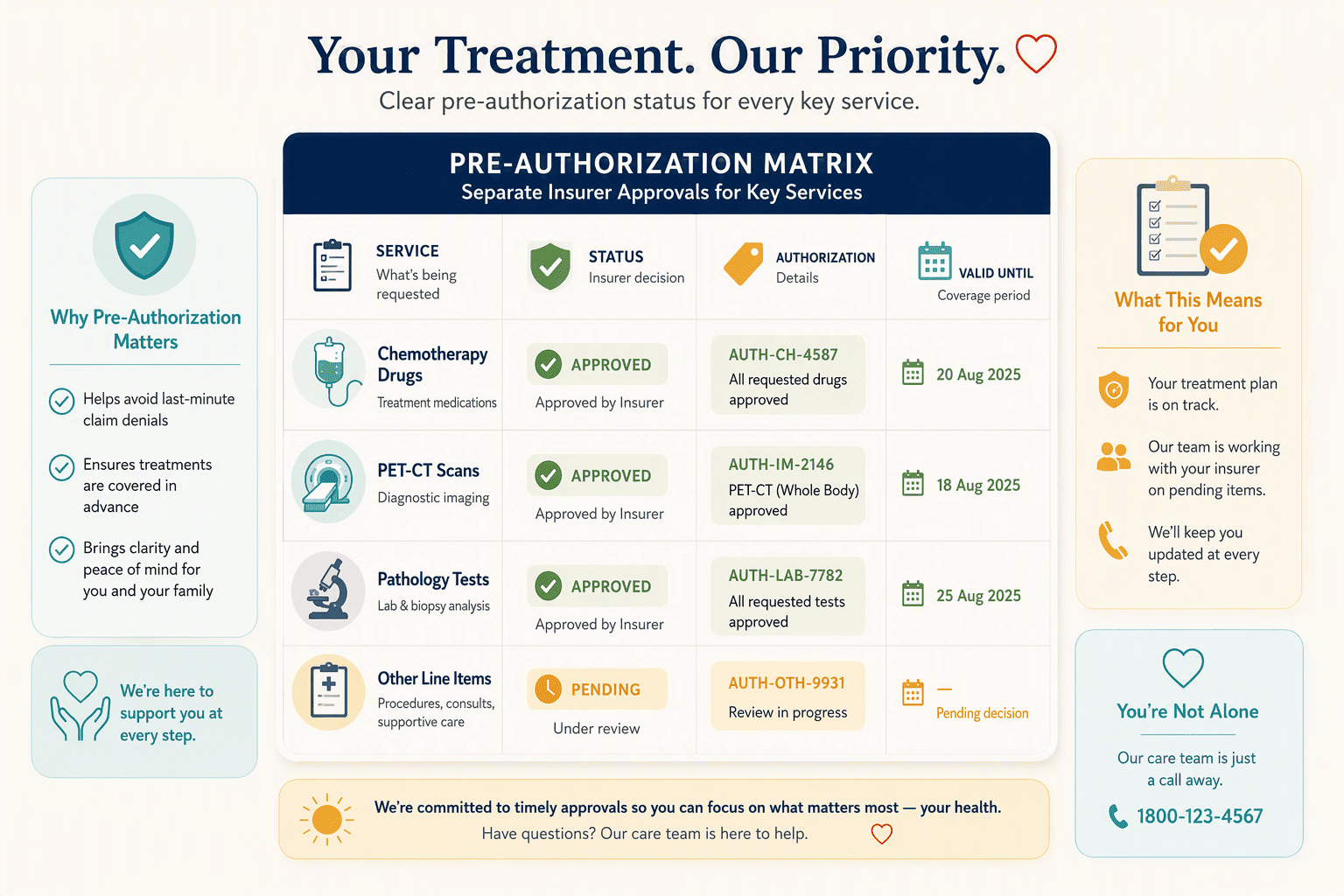
The most common reason for claim rejection is assuming that 'chemotherapy cover' applies to the entire treatment ecosystem. Insurers treat each component as a separate line item requiring individual approval. Before your first appointment, demand a written pre-authorization grid that separates drugs from diagnostics.
You must verify coverage for the expensive diagnostics that guide treatment decisions. A single PET-CT scan can cost upwards of ₹15,000, and many standard policies either cap radiology or exclude it until a deductible is met. Similarly, molecular pathology and genomic testing like BRCA gene analysis, which are critical for targeted therapy selection, are frequently classified under 'advanced diagnostics' and require separate approval. Do not overlook the cost of supportive medications. Drugs like G-CSF injections, used to boost white blood counts between cycles, can add thousands to your monthly out-of-pocket spend if the policy classifies them as 'nutritional supplements' rather than cancer-directed therapy.
Centers that practice thorough care understand these administrative bottlenecks. When assessing a center, ask how their billing department handles 'drug master list' verification. A proficient insurance desk will pre-check your policy's formulary list against the oncologist's prescription to flag exclusions before the infusion starts, a step that prevents you from receiving a surprise bill for a drug that the insurer retroactively deems non-key.
Step 5: Master the Pre-Authorization and Billing Questions
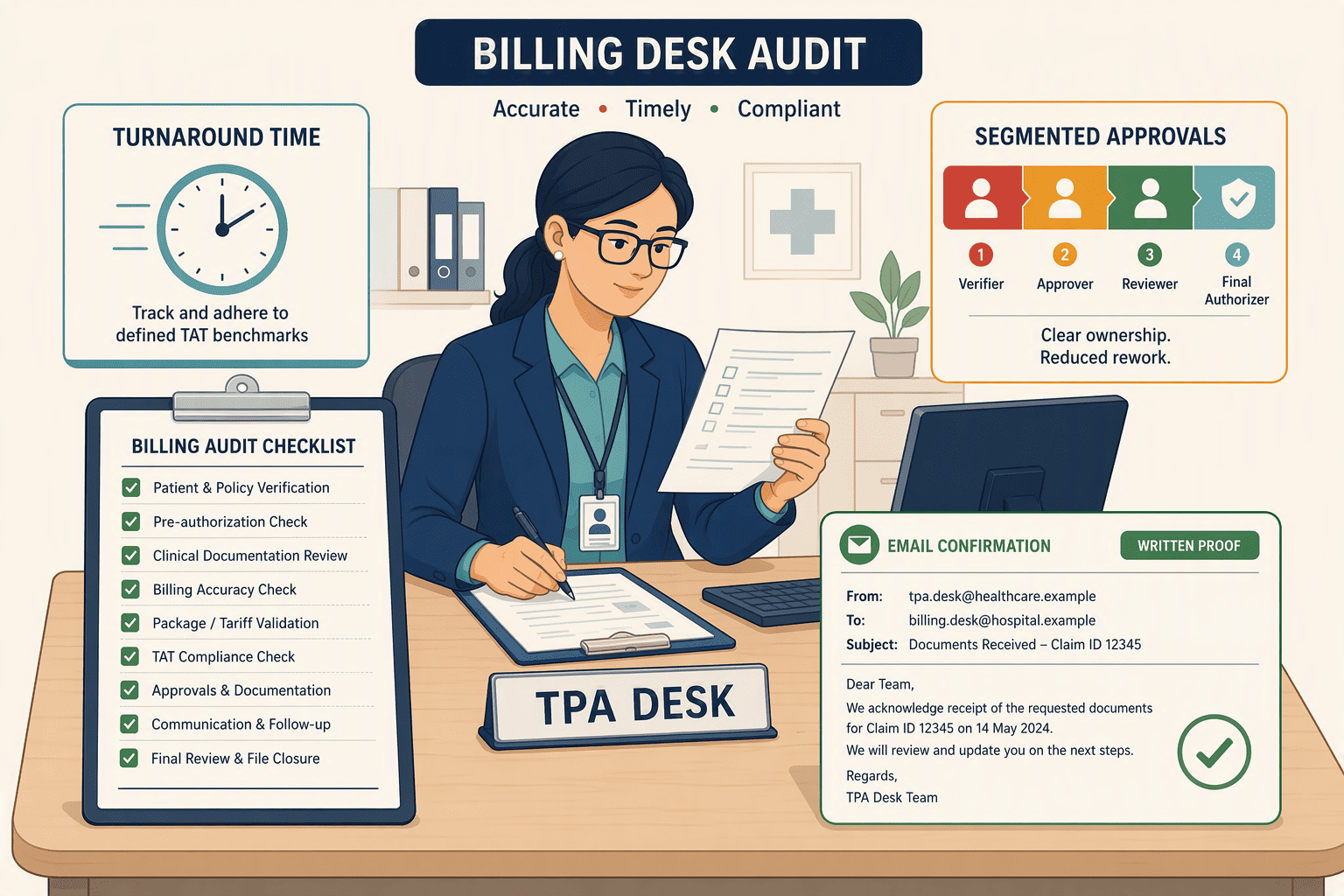
When you sit down with the hospital's billing or TPA desk, you are not asking for a favor. You are auditing their process. Walk in with a precise checklist and refuse to leave until you have answers in writing, from an official hospital email address.
- Guaranteed turnaround time: What is the timeline between the hospital submitting your file and the insurer approving the first cycle? Delays here directly affect cancer progression.
- Segmented approvals: The generic chemotherapy cocktail may be approved under one authorization code, while a separate, high-cost monoclonal antibody needs a second, independent approval that can add another 24 to 72 hours.
- Documentation for multi-policy claims: Nail down the specific documents your insurer requires, including the primary insurer's remittance advice, original pharmacy purchase invoices with batch numbers, and the histopathology report that justifies the treatment line.
Step 6: Navigate Cashless and Reimbursement Claim Support
Cashless hospitalization lets the hospital and insurer settle the bill at an agreed tariff, so you bypass the strain of arranging lakhs for a medical crisis. The facility gets paid directly, and your liquidity stays off the table.
Reimbursement puts you on the hook for the full amount first. You pay the hospital, then file for a refund. Every document matters: original itemized bills, a signed discharge summary, doctor's prescriptions with registration numbers, pharmacy invoices, and diagnostic reports.
Miss one, and the claim stalls when you can least afford a delay. For centers that run a multi-insurer cashless system, check whether their billing desk can produce a split invoice.
This statement breaks out the portion the primary insurer covered so the secondary insurer receives a clear picture of the remaining liability. That single document removes the rejection reason that the claim form does not reflect the primary settlement.
Step 7: Coordinate Multiple Insurer Approvals at a Single Center
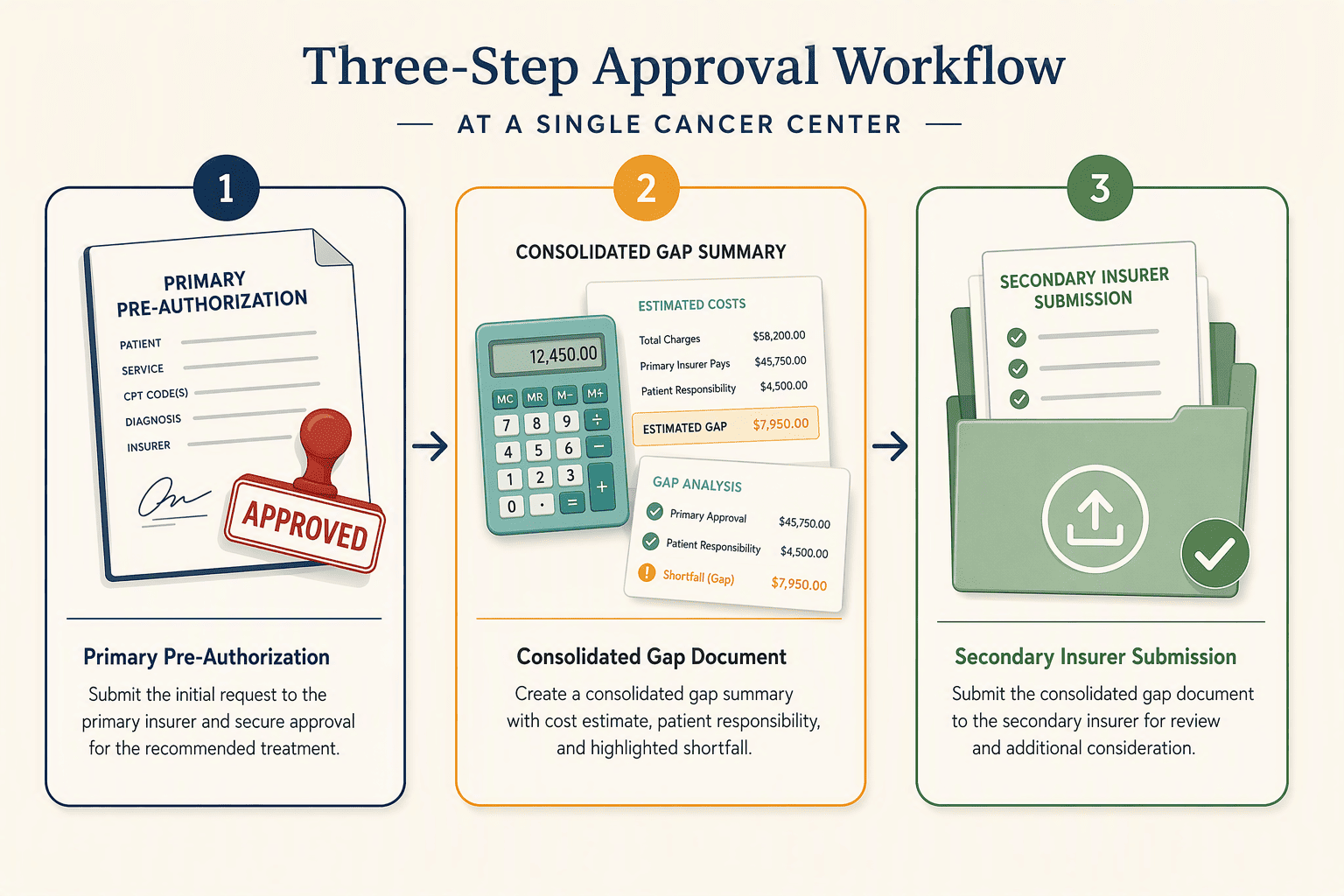
This is the sequence that prevents administrative gridlock. The failure mode here is approaching all insurers simultaneously with incomplete paperwork, which triggers conflicting queries and stalls everything.
- File for primary pre-authorization: Start by securing the primary insurer's pre-authorization approval letter.
- Compile a gap document: With that approval in hand, create a consolidated cost estimate showing the primary insurer's approved limit and the explicitly calculated shortfall.
- Submit to the secondary insurer: Provide the gap document along with the primary approval to the secondary or top-up insurer.
Centers that handle this well often keep a corporate liaison desk. This team acts as a single point of contact who routes the primary settlement note to the secondary provider, making sure the coverage layers interlock without leaving you holding an unexpected deductible. Look for this setup at facilities that coordinate care across departments, such as some of the best cancer hospitals in Delhi NCR.
Conclusion
Securing a chemotherapy center that accepts multiple insurance plans is a test of administrative precision, not luck. The pathway runs through direct insurer verification, granular pre-authorization of every drug and scan, and a clear strategy for stacking primary and secondary coverage. Do not wait for the hospital to tell you what is possible. Define your financial coverage chain early, present it to the billing desk in a structured format, and demand that the paperwork meets your clinical timeline. The priority remains your treatment; getting the bureaucracy right simply ensures that cost does not override care.
Frequently Asked Questions
What is a multi-disciplinary tumor board and does it affect which insurance is accepted?
A multi-disciplinary tumor board is a meeting where surgical, medical, and radiation oncologists review a case collectively to decide on an optimal treatment plan. It improves your clinical care quality but does not directly influence your insurance acceptance. Insurers approve claims based on their network agreements with the hospital, not the hospital's internal clinical meeting structure.
How do I verify whether a chemotherapy center is in-network for my specific insurance plan in India?
Log in to your insurer's official website or mobile app and use the 'Hospital Locator' tool by entering the center's name and city. Cross-reference this by calling the insurer's helpline and asking a representative to confirm cashless eligibility specifically for your policy membership number and the planned chemotherapy procedure.
What is the typical cost of chemotherapy in India and how do multiple insurance plans help cover it?
Complete cancer treatment can range from ₹5 lakh to over ₹25 lakh. Advanced immunotherapy cycles cost ₹1 to 3 lakh each. Multiple insurance plans help by layering coverage: a primary corporate policy might cover standard chemo, while a secondary or top-up plan activates after the primary limit is exhausted to cover these expensive targeted drugs.
Which questions about billing and pre-authorization should I ask a hospital before starting chemotherapy?
When meeting hospital billing or TPA staff, ensure you get written answers from an official hospital email address for these critical questions:
- Guaranteed turnaround time: What is the timeline for pre-authorization approval for the first cycle?
- Separate approval for high-cost drugs: Do expensive targeted therapies or monoclonal antibodies require a separate approval from standard chemo?
- Documents for secondary claim: What specific papers (e.g., primary insurer remittance advice, original pharmacy invoices, histopathology report) are needed?
- Split invoice capability: Can the hospital generate a statement showing the exact balance remaining after the primary insurer settles?
What kind of cashless and reimbursement claim support do oncology hospitals in India offer?
Most network hospitals offer a cashless facility where they settle approved claims directly with the insurer. If a hospital is not in-network, or for specific exclusions, they support reimbursement by providing an itemized final bill, signed discharge summary, and diagnostic reports, which you then submit to the insurer for a refund.
Sources
- Medical Oncology | Andromeda - www.andromedahospital.in
- 6 Best Cancer Hospitals in Delhi NCR for Comprehensive Care - www.andromedahospital.in
- Best Cancer Hospital in Delhi NCR | Top Cancer Specialists - www.andromedahospital.in
- Empanelment of Hospitals for Ayushman Bharat - www.pib.gov.in
- Cancer Treatment Cost in India: Complete Guide - joinditto.in