
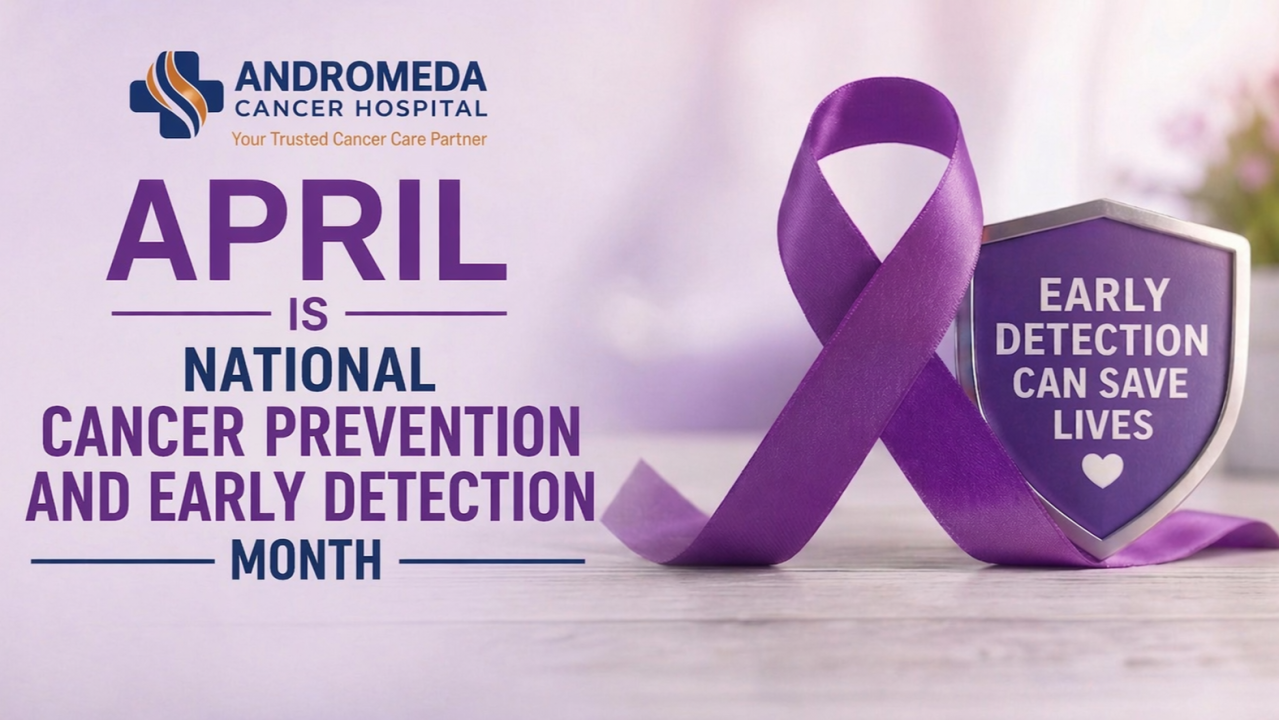
April is National Cancer Prevention and Early Detection Month, serving as a critical reminder to adopt healthy habits and prioritize regular screenings—because cancer is most treatable when detected early. Cancer is a serious health problem in the world and in India. As per GLOBOCAN 2022, there were about 2 crore (20 million) new cancer cases and about 97 lakh (9.7 million) deaths worldwide. In India, the ICMR estimates around 15.6 lakh (1.56 million) new cases and more than 8.7 lakh (874,000) deaths in 2024.
Research clearly shows two things:
- Large number of cancers can be prevented
- Finding cancer early greatly improves chances of cure
This article shares proven ways to reduce cancer risk, clears some common myths, and explains why early check-ups and screening matter.
Cancer Prevention: Proven Ways to Reduce Risk
The World Health Organization (WHO) says about 30–50% of cancers can be prevented by changing known risk factors. This is based on many years of research, not guesswork.
1. Tobacco (Smoking and Chewing): The Biggest Avoidable Risk
Tobacco is the number one cause of cancer that we can prevent.
- It is linked to about 22% of cancer deaths worldwide.
- It strongly increases the risk of:
In India, chewing tobacco (gutkha, khaini, zarda, paan with tobacco, etc.) is a major reason why mouth cancer is so common.
What happens in the body (simple): Tobacco has many harmful chemicals that damage our body cells and DNA. Over time, this damage can turn normal cells into cancer.
Stopping tobacco lowers risk—even if someone has used it for many years.
2. Being Overweight, Food Habits, and Diabetes-Related Factors
Being overweight and having an unhealthy diet can increase the risk of some cancers.
- Extra body weight is linked with higher risk of:
Why this happens:
- Being overweight leads to a state of ongoing inflammation.
- It can lead to insulin resistance and poor blood sugar control.
- It increased insulin like growth factor (IGF) levels that can support cancer growth.
Some food habits that can increase risk:
- Eating a lot of processed meat (packed/processed meats) is linked to colon cancer.
- Eating too little fibre (fruits, vegetables, whole grains) may reduce protection for the gut.
3. Alcohol: Increases Cancer Risk
Alcohol is a proven cause of cancer. (It is in the highest risk category, like tobacco.)
- It is linked with higher risk of cancer of the:
Why alcohol increases risk (simple): When the body breaks down alcohol, it forms harmful substances that can damage DNA and make it easier for cancer to develop.
4. Infections That Can Cause Cancer (And Many Are Preventable)
In India, a good number of cancers are linked to certain infections.
- HPV (Human Papillomavirus) can lead to cervical cancer (cancer of the mouth of the uterus).
- Hepatitis B (HBV) can lead to liver cancer.
India has a large number of cervical cancer cases compared to many other countries.
Important fact: In India, about one woman dies from cervical cancer roughly every 8 minutes.
How to prevent these:
- The HPV vaccine can prevent most high-risk HPV infections (more than 90% protection against the types it targets).
- The Hepatitis B vaccine lowers the risk of long-term HBV infection and helps prevent liver cancer.
5. Not Being Physically Active
Sitting for long hours and not exercising can increase cancer risk because it can lead to:
- Weight gain
- Hormone changes
- Weaker body defence (immune system) over time
Regular activity (like brisk walking, cycling, or any daily exercise) is linked with lower cancer risk and better health overall.
6. Pollution and Workplace Exposure
Research also shows risk from:
- Air pollution (especially for lung health)
- Some workplace chemicals (for example, asbestos and industrial chemicals)
In many Indian cities, pollution levels are high. Doctors now see more cases of lung cancer even in people who never smoked.

Myths and Facts: Clearing Common Misconceptions
Wrong information can delay diagnosis and treatment. Let’s correct a few common myths:
Myth 1: “Cancer happens only because of family history (genes).”
Fact: Only about 5–10% of cancers are truly hereditary. Most cancers are linked to lifestyle, environment, infections, or age.
Myth 2: “If I don’t smoke, I can’t get cancer.”
Fact: Non-smokers can also get cancer due to:
- Air pollution
- Unhealthy food habits and obesity
- Some infections (like HPV, Hepatitis B)
- Family history or genes (in some cases)
Myth 3: “If I live healthy, I will never get cancer.”
Fact: Healthy habits reduce the risk, but they cannot make the risk zero. Many factors play a role.
Myth 4: “If I have no symptoms, I don’t need screening.”
Fact: Screening is done to find cancer before symptoms start, when treatment is often easier and the chance of cure is higher.
Myth 5: “Biopsy or surgery spreads cancer.”
Fact: There is no scientific proof that a biopsy spreads cancer. A biopsy is often necessary to confirm cancer and plan the right treatment.
Myth 6: “Cervical cancer cannot be prevented.”
Fact: Cervical cancer is one of the most preventable cancers with HPV vaccination and regular screening.
Early Detection: Why Finding Cancer Early Saves Lives
Early detection is not just advice—it is one of the strongest reasons people survive cancer.
Cancer usually starts small and then grows. If it is found early, before it spreads, treatment can be simpler and outcomes are better. Finding it early can improve:
- How big the cancer is (tumor burden)
- How strong the treatment needs to be (treatment intensity)
- Chances of survival
- Quality of life after treatment
How Early Detection Improves Results
In simple terms:
- Early-stage cancer (Stage 1) is often limited to one area and can be treated successfully in most cases.
- Late-stage cancer (Stage 3–4) may have spread, so treatment is usually more complex and outcomes may be poorer.
Example (breast cancer):
- If found early, breast cancer patients have more than 90–95% chance of survival at 5 years.
- If found late, survival is much lower.
So, how early the cancer is found is one of the biggest factors that decides the result of treatment.
Two Ways to Find Cancer Early
There are two main ways:
1. Screening (Tests Done Before Symptoms)
Screening means doing certain tests in people who feel fine, so cancer can be found early.
Good screening programs need:
- The right test (scan or lab test) that can catch early changes
- Knowing who needs the test more (higher-risk people)
- Quick follow-up if the test shows something suspicious
Examples include:
- Mammography for breast cancer
- Pap smear / HPV test for cervical cancer
- Mouth check-up for people at high risk (especially tobacco users)
Screening can reduce deaths from some cancers, especially breast and cervical cancer.
2. Early Diagnosis (Not Ignoring Warning Signs)
If symptoms start, it is important to get checked quickly.
In India, cancer is often found late because:
- People ignore symptoms or wait too long
- Lack of awareness about warning signs
- Getting treated first by someone who is not trained to check cancer
If any symptom continues for more than 2–3 weeks, it is safer to get a proper check-up. Warning signs can include:
- Weight loss without trying
- Cough that does not go away, or change in voice
- Wound/ulcer that is not healing
- Bleeding that is not normal
- Any lump, especially new/growing
Getting checked early can lead to:
- Finding the cancer at an earlier stage
- Simpler treatment in many cases
- Better chances of recovery
How Doctors Confirm Cancer (Simple Steps)
To confirm cancer, doctors usually follow a step-by-step process:
- Doctor check-up (history and physical examination)
- Scans/tests (to see where the problem is and how big it is)
- Biopsy (taking a small tissue sample to confirm cancer)
This helps ensure:
- Correct diagnosis
- Less delay in starting treatment
- Fewer unnecessary referrals and repeat tests
Early Detection at Andromeda Cancer Hospital: What We Offer
At Andromeda Cancer Hospital, we focus on finding cancer early through a team-based approach and modern testing facilities, in line with global standards.
1. Modern Tests and Scans
We have modern diagnostic facilities to help find cancer early and accurately, such as:
- 3D Mammography (very sensitive for small breast cancers)
- High-quality ultrasoundand elastography
- Image-guided biopsy (biopsy done with scan guidance for accuracy)
- PET-CT and other advanced scans (to check cancer spread)
These tests help doctors find:
- Very small early changes
- Early-stage cancers
- Early signs of spread (when present)
This reduces the chance of missing a problem or finding it too late.
2. Screening and Preventive Care
We support screening and prevention through:
- Breast cancer screening
- Genetic counselling and testing (for families with strong cancer history)
- Personalized screening plans based on your risk
This matters because in India, many people reach a hospital when the cancer is already at a later stage.
- Many cancers are found in Stage 2–3 instead of Stage 1.
3. Team of Specialists (All in One Place)
One of the key differentiators is the multidisciplinary team (MDT) approach, involving:
- Surgical oncologists
- Medical oncologists
- Radiation oncologists
- Radiologists and pathologists
This ensures:
- Comprehensive evaluation in a single setting
- Faster decision-making
- Evidence-based, individualized treatment planning
4. Integrated Diagnostic-to-Treatment Pathway
A critical issue in cancer care is delay between diagnosis and treatment.
At Andromeda:
- Diagnostics, staging, and treatment planning are integrated under one roof
- Minimizes patient movement between centers
- Enables early initiation of treatment, which is crucial for outcomes
5. Full Spectrum Oncology Services Supporting Early Detection
The hospital provides a complete continuum of care, including:
- Surgical Oncology (including minimally invasive and robotic surgery)
- Medical Oncology (chemotherapy, immunotherapy, targeted therapy)
- Radiation Oncology with advanced precision techniques
- Oncopathology and radiology services for accurate diagnosis
- Pain and palliative care for holistic patient support
- Rehabilitation and physiotherapy services
This integrated model ensures that early detection seamlessly translates into effective treatment.
Closing Perspective: From Awareness to Action
Cancer care is no longer limited to treatment—it begins much earlier, with risk reduction and early identification.
The scientific evidence is clear:
- A significant proportion of cancers are preventable
- Early detection dramatically improves survival
- Delays in diagnosis remain one of the biggest challenges in India
Improving cancer outcomes depends on timely detection, informed decisions, and access to the right care without delay.
At Andromeda Cancer Hospital, we are committed to providing comprehensive cancer care—from early screening and accurate diagnosis to advanced treatment—under one roof, supported by a multidisciplinary team and modern technology.
If you or your loved ones have any concerns or are due for screening, do not delay seeking medical advice. 📞For appointments and consultations: 9138111625
Andromeda Cancer Hospital – Your Trusted Cancer Care Partner.
#CancerPrevention#EarlyDetectionSavesLives#CancerAwareness#OncologyCare#PreventiveHealthcare