

Navigating cancer treatment costs in India becomes manageable when you know which government insurance schemes cover empaneled hospitals in your region.
This guide walks you through eligibility verification, hospital empanelment, and fallback programs when insurance coverage falls short.
Key Takeaways
- Ayushman Bharat PM-JAY provides ₹5 lakh annual coverage per family, with state top-ups like Haryana CMCHIS (₹3 lakh) and Delhi DDSSY (₹5 lakh) extending total limits to ₹8-10 lakh
- Eligibility depends on SECC 2011 database inclusion rather than income thresholds — verify status through the PM-JAY helpline 14555 before hospital admission
- Major government oncology centers (Tata Memorial, AIIMS Delhi) accept PM-JAY and offer additional subsidy tiers for BPL patients, covering 50-100% of treatment costs
- Outpatient diagnostics (PET scans, biopsies) and oral chemotherapy drugs typically fall outside PM-JAY coverage, requiring charitable programs or pharmaceutical patient assistance programs
- Verify hospital empanelment status directly via the PM-JAY portal or hospital billing desk — logos and accreditation do not guarantee current coverage
Understanding Government Health Insurance for Cancer Care in India
Government health insurance schemes like Ayushman Bharat Pradhan Mantri Jan Arogya Yojana (PM-JAY) and state-level top-ups enable economically weaker families to access empaneled cancer treatment centers, covering up to ₹5 lakh per family annually for hospitalization — yet outpatient diagnostics, follow-up consultations, and certain targeted therapies remain out-of-pocket expenses. Eligibility hinges on inclusion in the SECC 2011 database or possession of a valid ration card, documentation requirements that many online hospital listings omit but that determine whether a patient can activate cashless treatment at empaneled facilities.
Ayushman Bharat Pm-Jay Coverage Scope
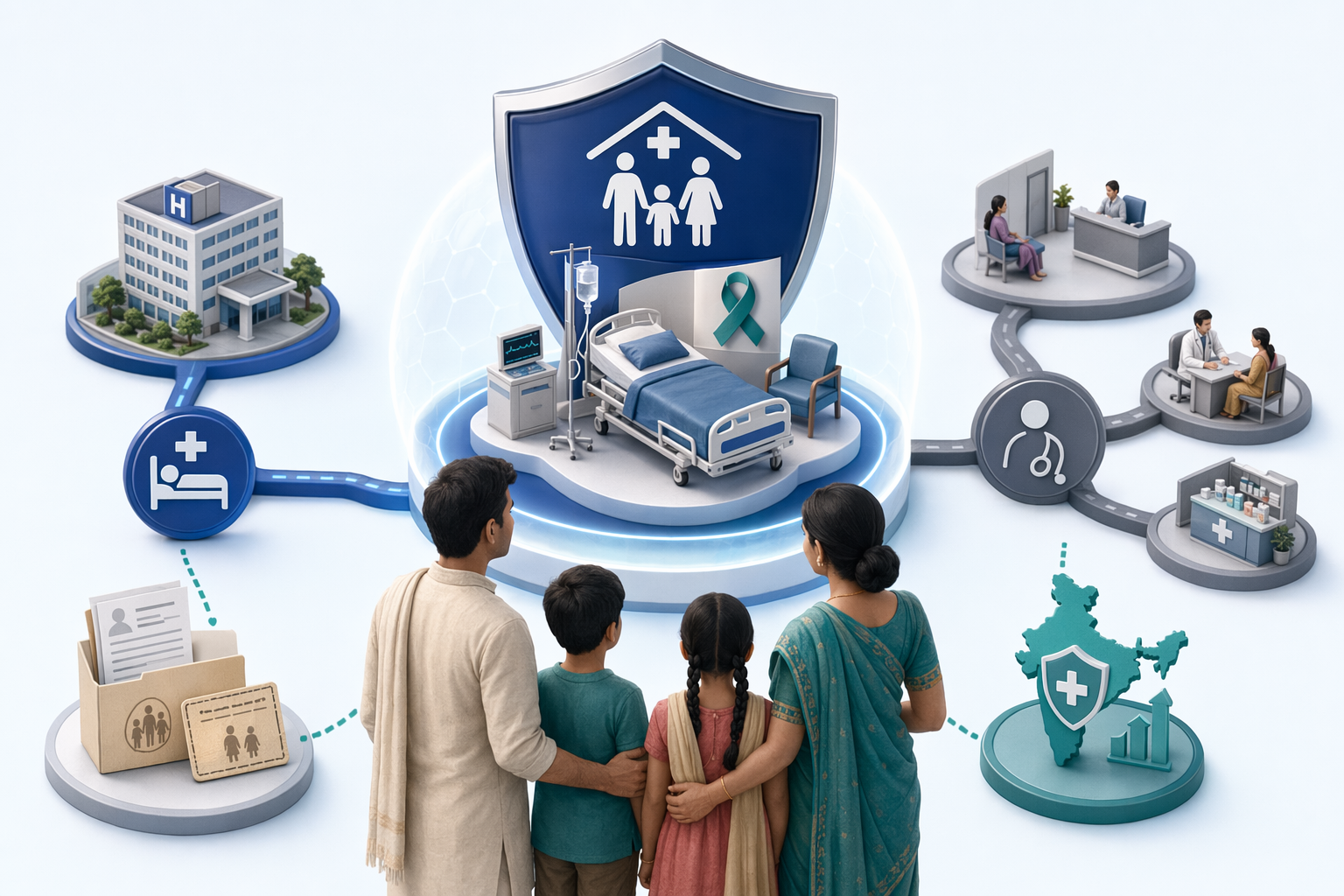
PM-JAY provides cashless health insurance coverage of up to ₹5 lakh per family per year for secondary and tertiary care hospitalization at empaneled public and private hospitals. The scheme covers over 1,500 medical procedures, including cancer surgeries, inpatient chemotherapy, radiation therapy, and related hospitalization costs. Pre-hospitalization expenses are reimbursed for up to 3 days and post-hospitalization care for up to 15 days, reducing the immediate financial burden on families during active treatment phases.
What Costs Remain Out-Of-Pocket
Despite PM-JAY's broad coverage, outpatient diagnostics — including PET-CT scans, MRI imaging, and molecular pathology — are typically excluded, leaving families to bear these expenses before admission. Post-treatment follow-up consultations, supportive medications, and newer targeted therapy drugs not yet included in the scheme's package rates also fall outside the ₹5 lakh limit. High-cost precision medicines and immunotherapy regimens may require separate out-of-pocket payment or supplemental insurance, perpetuating financial toxicity even for insured patients.
State-Level Top-Up Schemes Overview
Northern India states have layered additional coverage onto PM-JAY: Haryana's Chief Minister's Cancer Relief Fund Society (CMCHIS) extends support for diagnostics and specialized drugs; Delhi's Deendayal Sehat Sahayog Yojana (DDSSY) adds coverage for outpatient chemotherapy; Punjab's Mukh Mantri Punjab Jan Arogya Yojana (MJPJAY) increases the family ceiling beyond ₹5 lakh; and Uttar Pradesh's state health schemes offer supplementary packages for pediatric cancers. Patients residing in these states should verify eligibility and empanelment status at their chosen facility to activate combined central-and-state benefits, maximizing cashless treatment scope before incurring out-of-pocket costs.
Before exploring empaneled hospitals, confirm your household qualifies for PM-JAY coverage using the SECC 2011 database.
Step 1: Check Your Eligibility for Ayushman Bharat Pm-Jay
Ayushman Bharat Pradhan Mantri Jan Arogya Yojana (PM-JAY) extends health coverage of up to ₹5 lakh per family per year to households identified in the Socio-Economic Caste Census (SECC) 2011 database. Before beginning cancer treatment at any empanelled facility, patients must confirm their household appears in the SECC list and gather the required documentation.
Income Thresholds and SECC Database Verification
PM-JAY eligibility is determined by SECC 2011 deprivation criteria rather than a single income cutoff. Rural households qualify if they meet occupation-based, housing, or sanitation markers; urban households qualify through 11 occupation categories covering informal workers and low-income groups. To verify your household's inclusion:
- Visit the PM-JAY beneficiary verification portal at pmjay.gov.in and enter your mobile number or ration card details.
- Call the PM-JAY helpline at 14555 to request eligibility confirmation over the phone.
- Check with your district's Ayushman Mitra or Common Service Centre (CSC) operator, who can search the SECC database on your behalf.
If your household does not appear in the SECC database but meets current deprivation criteria, contact your state nodal agency — some states have expanded coverage beyond the original 2011 list.
Documentation Checklist for Pm-Jay Enrollment
Once SECC eligibility is confirmed, gather the following documents before approaching an empanelled hospital:
- Ration card (preferably BPL or Antyodaya) showing the family head's name.
- SECC inclusion proof, a printed copy of your SECC household record from the PM-JAY portal or a certificate from the local panchayat/municipality.
- Aadhaar card for the patient and, if available, for other family members listed in the SECC record.
- Income certificate (if required by your state nodal agency), issued by a tehsildar or authorized revenue officer.
- Discharge summary or diagnostic report from a prior hospital visit, if cancer diagnosis has already been established.
Carry original documents plus one photocopy of each. Empanelled hospitals, including facilities in northern India such as Andromeda Cancer Hospital (https://www.andromedahospital.in/), will verify these documents against the PM-JAY beneficiary database during the admission process. Specialized cancer insurance policies are also available to patients seeking supplemental coverage beyond government schemes, though PM-JAY remains the primary route for economically weaker households.
If any document is missing or your SECC record shows discrepancies, resolve these with your district administration before scheduling treatment, incomplete documentation will delay cashless approval and may require upfront payment.
Once you confirm PM-JAY eligibility, check whether your state offers supplemental coverage that increases total treatment limits.
Step 2: Explore State-Level Health Schemes (Haryana, Delhi, Punjab, UP)
State governments in Northern India supplement PM-JAY with top-up schemes that extend coverage limits and expand eligibility for cancer treatment. Understanding these programs is key for residents of Haryana, Delhi-NCR, Punjab, and Uttar Pradesh seeking affordable chemotherapy and medical oncology services.
Haryana Chirayu Maitri Cancer Health Insurance Scheme (Cmchis)
Haryana's CMCHIS provides a ₹3 lakh top-up over PM-JAY's ₹5 lakh base, bringing total coverage to ₹8 lakh per family annually. Enrollment requires a valid Haryana ration card, Aadhaar card, and residence proof (utility bill or property document). Applications are processed at district health offices or through the Ayushman Bharat digital portal during open enrollment windows (typically April-June). Both government and empaneled private hospitals across Delhi NCR accept CMCHIS for cashless treatment.
Delhi Delhi Sarvodaya Swasthya Yojana (Ddssy) and Punjab Mjpjay
Delhi residents benefit from DDSSY's ₹5 lakh coverage (stackable with PM-JAY for ₹10 lakh total). Applicants must provide a Delhi domicile certificate, voter ID, and income certificate below the state threshold. Punjab's Mukh Mantri Jeewan Jyoti Aarogya Yojana (MJPJAY) offers similar top-up provisions, with enrollment processed through Punjab Health Department portals. Both schemes cover pre-operative diagnostics and post-operative supportive care often excluded from central schemes.
Uttar Pradesh Government Health Schemes for Cancer
Uttar Pradesh operates district-level health schemes with coverage limits varying by district (₹2 to 4 lakh typical). Enrollment windows align with financial quarters (July-September, October-December). Applicants submit BPL cards, Aadhaar, and district residence certificates at CHC or district hospital help desks. Coverage includes chemotherapy, radiation therapy, and palliative care at empaneled centers.
| State Scheme | Coverage Limit | Eligibility Documents | Enrollment Process |
|---|---|---|---|
| Haryana CMCHIS | ₹3 lakh top-up (₹8 lakh total with PM-JAY) | Ration card, Aadhaar, residence proof | District health office or Ayushman portal (April-June) |
| Delhi DDSSY | ₹5 lakh (₹10 lakh total with PM-JAY) | Domicile certificate, voter ID, income certificate | Delhi Health Department portal or district offices |
| Punjab MJPJAY | Top-up varies (₹3-5 lakh typical) | Punjab residence proof, Aadhaar, BPL/APL card | Punjab Health portal or CHC enrollment centers |
| UP District Schemes | ₹2-4 lakh (district-dependent) | BPL card, Aadhaar, district residence certificate | CHC or district hospital help desks (quarterly windows) |
Andromeda Cancer Hospital, located in Haryana near the Delhi border, accepts CMCHIS and DDSSY for cancer treatment. Patients are advised to verify scheme acceptance and documentation requirements at the time of admission.
With eligibility and state schemes confirmed, the next step is identifying cancer centers that accept your coverage without surprises at admission.
Step 3: Identify Empaneled Cancer Treatment Centers in Your Region
Using the Pm-Jay Online Empanelment Portal
The official PM-JAY hospital list is your starting point, assumptions about facility size or accreditation do not confirm coverage. Follow these steps to verify a hospital's participation status before scheduling treatment:
Visit the PM-JAY portal (www.pmjay.gov.in) and navigate to the 'Find a Hospital' section.
- Select your state (Haryana, Delhi, Punjab, Uttar Pradesh) and district from the dropdown menus.
- Search for the facility by name or browse the empaneled list filtered by specialty (oncology, chemotherapy).
- Confirm the hospital's participation status, look for an active empanelment certificate number and coverage details displayed on the portal.
Cross-check this information by calling the hospital's billing desk and asking for the official empanelment letter, many facilities display the PM-JAY logo but have expired or partial coverage that excludes chemotherapy packages.
Government Hospitals: Tata Memorial, Aiims, Regional Cancer Centres
Major government oncology centers in Northern India accept PM-JAY and offer additional subsidy tiers for economically weaker patients. Tata Memorial Centre, founded in 1941 by the House of Tatas, has evolved to over 10 hospitals in 6 different states and provides charitable waivers (50-100% waiver for BPL patients) beyond PM-JAY coverage. AIIMS New Delhi and Rajiv Gandhi Cancer Institute and Research Centre (RGCIRC) similarly participate in both central and state insurance schemes.
These institutions are equipped with the latest technology and advanced treatment options, including cutting-edge surgical procedures, radiotherapy, chemotherapy, and immunotherapy, and train 70% of cancer-specialty human resources in the country. Verify each facility's current empanelment status on the PM-JAY portal, government hospitals sometimes have separate application processes for state-specific schemes like CMCHIS (Haryana) or Delhi Arogya Kosh.
Private Empaneled Hospitals in Haryana, Delhi NCR, Punjab
Private hospitals like Max Healthcare in Delhi offer thorough cancer care through multidisciplinary teams, but empanelment status varies by location and package, the PM-JAY portal shows which Max facilities accept central schemes versus state-specific coverage. Before admission, ask the billing desk for the official empanelment letter and confirm which chemotherapy protocols are covered under cashless treatment.
Andromeda Cancer Hospital in Sushant City, Kundli, Sonipat serves Haryana, Delhi-NCR, and Northern India with multidisciplinary oncology services, readers must verify empanelment status via the official PM-JAY portal and state helplines, as brand facts do not confirm PM-JAY acceptance. Strengths: located in Haryana/Delhi NCR (the article's geographic focus), offers surgical oncology, medical oncology, radiation oncology, and anesthesia under one roof. Limitations: patients should cross-check empanelment on government portals before assuming coverage. Best-for: patients in Haryana/Delhi seeking a single-facility care pathway who will verify insurance acceptance through official channels before scheduling treatment.
Even empaneled hospitals may leave coverage gaps for diagnostics, targeted therapies, or supportive medications, charitable foundations fill these holes.
Charitable Foundations and Patient Assistance Programs
When government insurance coverage falls short or patients don't qualify for schemes like PM-JAY, charitable foundations and pharmaceutical patient assistance programs (PAPs) serve as critical fallback pathways for managing cancer treatment costs.

Tata Memorial Hospital Charitable Patient Programs
Tata Memorial Hospital operates a tiered subsidy system for patients whose income falls below poverty-line thresholds. Below Poverty Line (BPL) patients can receive 50 to 100% cost waivers even when PM-JAY coverage is exhausted. To apply, patients must submit income certificates, a treatment cost estimate from an oncologist, and proof of hospital registration. Processing timelines typically range from 2 to 4 weeks for subsidy approval, though emergency cases may receive expedited review.
Indian Cancer Society and NGO Financial Assistance
The Indian Cancer Society, along with NGOs like CanSupport and CRY, offers grants and subsidies to cover medication, surgery, and radiation costs. Application requirements mirror those for hospital programs, income proof, a detailed treatment plan, and a recommendation letter from the treating oncologist. Approval rates vary by foundation capacity and applicant volume, with decisions typically communicated within 3 to 6 weeks. Patients receiving care at centers like Andromeda Cancer Hospital can request the social work team to support charitable foundation applications.
Pharmaceutical Patient Assistance Programs (Paps)
Pharma companies, Novartis, Roche, and others, operate PAPs that reduce targeted therapy costs by 30 to 70%. Patients submit income proof and a prescription to the pharma company's India office; approval takes 2 to 4 weeks. Coverage typically applies to newer targeted therapies rather than traditional chemotherapy. Approval rates range from 40 to 60% for qualifying income brackets. Drugs like trastuzumab, imatinib, and pembrolizumab frequently appear on PAP formularies. Verify PAP eligibility and application deadlines directly with pharmaceutical companies, this section is informational only, not definitive guidance.
For patients facing high chemotherapy costs despite insurance, clinical trials offer investigational drugs at no cost, though understanding what trials don't cover matters equally.
Clinical Trials as a Cost-Reduction Pathway
For patients facing high chemotherapy costs, clinical trial participation can offset investigational drug expenses, but understanding what trials *do* and *don't* cover is critical to setting realistic expectations.
What Clinical Trials Cover (and What They Don't)
Most oncology trials provide the investigational drug at no cost, removing the single largest line item from a patient's treatment bill. However, hospitalization for infusion visits, imaging scans (CT, PET-CT), lab work, and monitoring appointments typically remain out-of-pocket expenses. Government insurance schemes like Ayushman Bharat may cover *some* of these ancillary costs if the trial site is an empaneled facility, but coverage varies by state and package limits. Before enrolling, confirm with the trial coordinator which costs are sponsored and which will fall to you, a trial that eliminates ₹2 lakh in drug costs but adds ₹50,000 in travel and monitoring expenses is still a net savings, but only if you budget for the gap.
Finding Oncology Trials in Northern India
Three registries serve as starting points: the ICMR Clinical Trials Registry (ctri.nic.in), the AIIMS trial portal, and ClinicalTrials.gov filtered for India. Typical inclusion criteria include cancer stage (often advanced-stage solid tumors), prior treatment history (some trials require first-line failure), and performance status (ECOG 0-2). Andromeda Cancer Hospital's tumor board can assess whether a patient's cancer type and stage make them a candidate for ongoing trials at regional centers like AIIMS or Tata Memorial, the board reviews pathology, imaging, and comorbidities in a single multidisciplinary discussion, then refers eligible patients to trial coordinators.
When government schemes and charitable programs still leave a funding shortfall, these fallback strategies can close the gap.
What to Do When Insurance Coverage Falls Short
Even with PM-JAY or state insurance, many patients face co-pays, uncovered drug costs, or treatment delays due to administrative processing. Research shows that 40 to 50% of cancer cases in India result in catastrophic health expenditure, forcing families to tap emergency financing, crowdfunding, or installment plans.
Crowdfunding Platforms and Campaign Success Rates
Medical crowdfunding platforms, Ketto, Milaap, ImpactGuru, offer a public fundraising route when government schemes cannot cover out-of-pocket gaps. Launch a campaign in parallel with your PM-JAY or state-scheme application; pre-authorization can take 7 to 14 days, but aggressive cancers demand immediate chemotherapy. Even insured patients often face uncovered expenses or delays in authorization, making crowdfunding a critical bridge.
To maximize campaign success, prepare:
- Medical reports and cost estimate from the treating hospital (itemized chemotherapy regimen, cycle count, total projected cost).
- Patient photo and brief story, platforms report higher donor engagement when campaigns include a clear narrative and image.
- Aadhaar or PAN card for KYC verification (required by most platforms before funds are released).
- Platform fee transparency, verify the service charge (typically 5 to 8% of funds raised) and ask whether tax deductions apply under Section 80G if the platform routes funds through a registered trust.
Typical campaign duration is 30 to 60 days; success rates vary widely (20 to 70%) depending on social-media reach, story clarity, and whether the hospital is empaneled with the platform's partner network. Andromeda Cancer Hospital provides cost estimates and documentation support for patients launching crowdfunding campaigns.
Hospital Payment Plans and Loan Options
Some private empaneled hospitals, Max, HCG, Andromeda, offer installment payment plans for chemotherapy cycles when upfront payment is unaffordable. In the U.S., cancer centers often provide in-house financing or direct insurance verification within 24 hours; in India, payment-plan availability depends on the hospital's internal policy and the patient's credit profile.
Expect interest rates of 10 to 18% per annum for medical loans from NBFCs (non-banking financial companies) or hospital-partnered lenders. Repayment terms typically span 6 to 24 months; longer terms reduce monthly burden but increase total interest paid. Ask the hospital billing desk whether they offer zero-interest installments for the first three chemotherapy cycles, some centers absorb the cost for deserving patients.
Government hospitals and charitable institutions rarely offer formal installment plans; most require either full upfront payment or proof of scheme coverage before starting treatment. If you cannot secure crowdfunding or a hospital payment plan, consult the hospital's social worker about deferred-payment arrangements or emergency financial assistance for patients below the poverty line.
Making Government Cancer Coverage Work for You
Government hospitals like Tata Memorial and AIIMS offer the deepest subsidies, 50-100% waivers for BPL patients, but have longer wait times for appointments and treatment slots. Private empaneled hospitals provide faster access but may have higher out-of-pocket costs even with scheme coverage. Crowdfunding platforms (Ketto, Milaap) can bridge affordability gaps quickly, with campaigns funded in 2-4 weeks, but require social media reach and storytelling effort; charitable foundation grants take longer to approve (4-8 weeks) but don't depend on public fundraising.
As the Ayushman Bharat Digital Mission expands in 2026-2027, real-time empanelment verification and pre-authorization approvals will become faster through the Ayushman Bharat Health Account (ABHA) portal, reducing the administrative burden on patients navigating multiple schemes across state lines.
Verify your eligibility for government schemes and for Andromeda Cancer Hospital's empanelment. Call the PM-JAY helpline (14555) or your state health department to confirm coverage before scheduling your first oncology consultation.
Frequently Asked Questions
Which cancer hospitals in Delhi accept Ayushman Bharat PM-JAY?
AIIMS New Delhi, Rajiv Gandhi Cancer Institute, and select private empaneled hospitals like Max Healthcare and Venkateshwar Hospital accept PM-JAY. Verify current empanelment status on the PM-JAY portal or call the helpline 14555 before admission, as coverage varies by hospital location and treatment package.
How much does chemotherapy cost in India without insurance?
Chemotherapy costs range from ₹1.5-4 lakh per course without insurance, varying by cancer type and regimen. Pharmaceutical patient assistance programs (PAPs) from Novartis, Roche, and others reduce targeted therapy costs by 30-70%. Patients submit income proof and prescription; approval takes 2-4 weeks.
Can I use Haryana CMCHIS and Ayushman Bharat PM-JAY together?
Yes, Haryana CMCHIS provides a ₹3 lakh top-up specifically for cancer treatment beyond PM-JAY's ₹5 lakh limit, giving combined coverage of ₹8 lakh. Patients use PM-JAY first, then CMCHIS covers additional costs up to the top-up limit for eligible treatments.
What documents do I need to apply for Ayushman Bharat PM-JAY?
You need four core documents: a ration card (BPL or eligible category), SECC 2011 inclusion proof (verify via online portal or helpline), Aadhaar card, and proof of residence. Some states require additional income certificates, contact your PM-JAY state nodal agency for state-specific requirements.
Does Tata Memorial Hospital offer free cancer treatment?
Tata Memorial Hospital provides subsidized treatment based on income tiers, BPL patients receive 50-100% fee waivers, while lower-middle-income patients get partial subsidies. These subsidies are separate from PM-JAY coverage, meaning patients can layer both benefit streams to minimize out-of-pocket costs.
How do pharmaceutical patient assistance programs work in India?
Patients submit income proof plus oncologist prescription to the pharma company's India office (Novartis, Roche, etc.). Approval takes 2-4 weeks, and approved patients receive 30-70% cost reduction on targeted therapies. PAPs typically cover drugs only, not hospitalization or monitoring costs.
What cancer treatment costs are NOT covered by Ayushman Bharat PM-JAY?
PM-JAY typically excludes outpatient diagnostics (PET scans, biopsies before admission), post-discharge follow-up consultations, oral chemotherapy drugs taken at home, and some targeted therapies. Check the PM-JAY package rate list for your specific procedure to confirm coverage before incurring expenses.
Sources
- Ayushman Card Hospital List 2026– PMJAY Empanelled - www.bajajfinserv.in (2026)
- (PDF) Facilitating Cancer Care Through Ayushman Bharat Scheme - www.researchgate.net (2023)
- Health Insurance for Cancer Patients in India - www.starhealth.in
- Best Cancer Hospital in Delhi NCR, India: Book Oncologist - www.maxhealthcare.in
- TMH_Brochure_ patient booklet - Tata Memorial Hospital - tmc.gov.in
- Best Cancer Hospitals in Delhi - Peace Medical Tourism - peacemedicaltourism.com
- Top 5 Charitable Cancer Hospitals in India - vshospitals.com
- Free Cancer Treatment in India: Government Hospitals & Schemes - www.ketto.org
- Choosing a Cancer Center or Hospital | American Cancer Society - www.cancer.org
- Journeys: understanding access, affordability and disruptions to cancer care in India - ecancer.org
- Cancer care and economic burden—A narrative review - journals.lww.com (2023)