
Introduction
The phrase "you need a mastectomy" can feel like a final verdict. It arrives in a sterile room, spoken with clinical certainty, and it erases the breast as a foregone conclusion. For decades, this conversation ended the same way for women across India. But in the leading cancer centres of Delhi NCR today, that verdict is increasingly overruled.
A quiet revolution has reshaped the standard of care. The modern approach pairs advanced imaging with molecular diagnostics, then routes every case through a multidisciplinary tumour board (MDT), a gathering of surgeons, medical oncologists, and radiation oncologists who argue the best path. Often, that path preserves the breast. When the starting point is collective intelligence rather than a single specialist's instinct, the first question becomes "do we need radical surgery at all."
When oncoplastic breast conservation techniques are deployed, removing the tumour while meticulously reconstructing the breast in a single sitting, the cure rate does not drop. A benchmark study found 93% concordance between an expert MDT and evidence-based treatment recommendations across 638 breast cancer cases, validating that team-driven decisions reliably land on personalized, guideline-aligned care. The right hospital brings that same consensus-based scrutiny to your diagnosis.
Key Takeaways
The hospital you choose determines whether conservation is even discussed. A hospital that defaults to mastectomy will rarely mention alternatives; a centre structured around breast preservation will exhaust every option before making that call. Here is what separates them.
- Multidisciplinary Tumour Board (MDT): A standing panel of surgical, medical, and radiation oncologists that reviews breast cases jointly before a treatment plan is recommended. An ad hoc phone call between departments is not the same thing.
- Oncoplastic Breast Conservation Surgery: Surgical expertise that integrates tumour resection with immediate aesthetic reconstruction to preserve shape and symmetry. Ask whether the hospital runs a named breast oncoplastic programme and how many such procedures its surgeons perform each year.
- On-Site Non-Surgical Therapies: In-house access to chemotherapy, immunotherapy, targeted therapy, and modern radiation (IMRT, IGRT, Tomotherapy). Without them, the word "multidisciplinary" means the centre refers you elsewhere for half the treatment.
- Integrated Diagnostics and Molecular Pathology: The ability to run receptor-subtype analysis (ER, PR, HER2) quickly on-site or through an established outsourced partner. The result tells you whether systemic therapy can downstage the tumour before any operation, and a delay in that result shrinks your window for conservation.
- A Stated Breast-Unit Model: Centres explicitly organised around organ-specific cancer management. Surgeons and radiologists who see breast cancer all day develop pattern recognition that a generalist who operates on the breast once a week cannot replicate.
- The question is not whether a hospital claims to be multidisciplinary. Nearly every hospital in Delhi NCR makes that claim now. The question is whether its structure, staffing, and daily workflow back it up in ways you can verify before you walk in for a consultation.
1. Andromeda Cancer Hospital, Gurugram
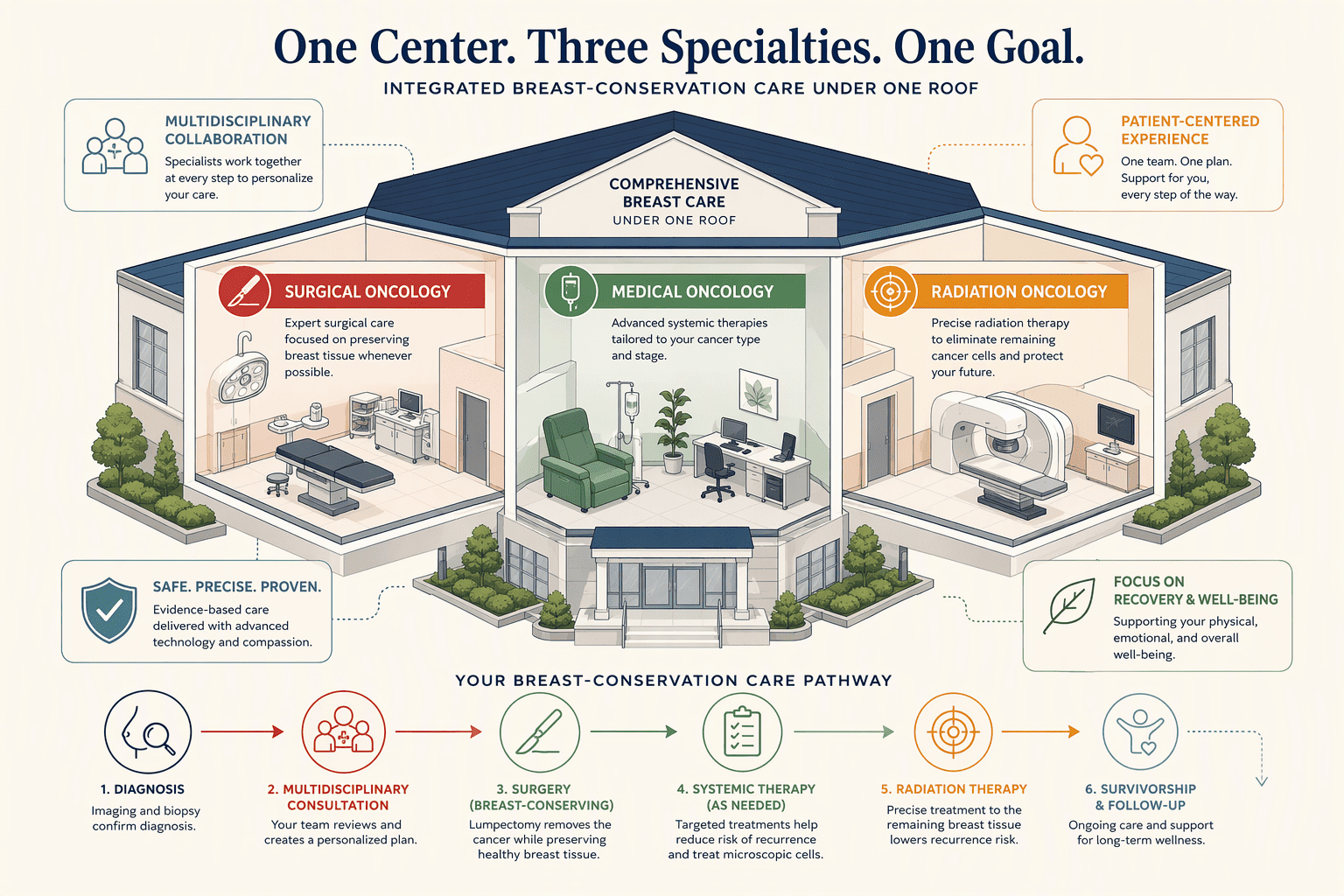
Andromeda Cancer Hospital runs the dedicated cancer-centre model where surgical, medical, and radiation oncology sit under one roof. That physical co-location is the foundation of genuine multidisciplinary care.
| Capability Dimension | Andromeda Cancer Hospital Offering |
|---|---|
| Oncoplastic Surgical Approach | Performs oncoplastic resections tailored to body habitus and tumour location; a stated breast oncology programme offers dedicated OPD consultations |
| Medical Oncology & Drug Therapies | Provides chemotherapy, immunotherapy, targeted therapy, and endocrine (hormone) therapy for breast cancer on-site; advances advanced drug therapy as part of the thorough armamentarium |
| Radiation Technology | Equipped with the Varian TrueBeam STx linear accelerator, enabling precision radiation delivery across radical, adjuvant, and palliative settings |
| Diagnostic Strength | On-site PET-CT imaging supports accurate staging and recurrence detection, reducing information lag between diagnosis and treatment planning |
| Clinical Scale | Operates as a 105-bed dedicated cancer hospital serving Haryana, Delhi NCR, Punjab, Uttar Pradesh, and northern India; houses a 20-bedded medical oncology ward and day-care chemotherapy centre |
A tumour board rounds on complex breast cancer cases, pulling the surgeon, medical oncologist, and radiation oncologist into the same conversation before a treatment path is locked. This coordinated review can shift the surgery timeline, the sequence of therapy, or the reconstruction plan based on what all three specialties see together.
2. Fortis Cancer Institute (FCI), Manesar
Fortis Cancer Institute (FCI) Manesar operates a defined Breast Oncoplastic programme led by female surgeons, placing breast conservation as a first-line priority from the first surgical consult.
- Dedicated Breast Oncoplastic Programme: The unit centres conservation and aesthetic reconstruction in surgical decision-making, naming oncoplastic breast conservation as a core capability for women seeking mastectomy alternatives.
- Robotic-Assisted Surgery Integration: FCI deploys robotic surgical platforms to support complex oncoplastic resections with precision, reducing collateral tissue damage and supporting quicker post-operative recovery for eligible cases.
- Molecular Diagnostics Loop: On-site molecular diagnostics feed tumour subtype data into the tumour board discussion. That information drives decisions about neoadjuvant chemotherapy or targeted therapy to shrink the tumour and widen the window for breast preservation.
- Tumour Board Synthesis: The institute structures its MDT to pull robotic surgery insights, molecular pathology, and systemic therapy options into a single sequenced plan. The model mirrors the approach validated by clinical research showing 93% concordance between multidisciplinary decisions and evidence-based, personalized care.
- Full Non-Surgical Suite: FCI houses chemotherapy, immunotherapy, targeted therapy, and radiation oncology on campus. A patient completes the entire multidisciplinary plan the tumour board designed without moving between far-flung facilities.
3. Rajiv Gandhi Cancer Institute and Research Centre (RGCIRC), Rohini
RGCIRC is a standalone oncology care centre established in 1996 that operates as a not-for-profit organization, building significant scale around organ-specific cancer management. Its surgical oncology, medical oncology, and radiation oncology departments function as distinct pillars that must collaborate, a structural feature that makes a true breast MDT feasible rather than aspirational.
Patient ratings of 4.5 from 1500 reviews reflect the high-volume trust placed in this Rohini institution, but the clinical signal you need to watch for is how its departmental structure channels a breast cancer patient into simultaneous conversations. RGCIRC's preventive oncology programme and pediatric hematology offerings indicate a center that thinks beyond the operating theatre, yet verifying that an oncoplastic breast surgeon sits among the MDT members, and that lumpectomy with immediate reconstruction is a routinely recommended pathway, is what separates a name on a list from a genuine breast conservation destination.
4. Indraprastha Apollo Hospitals, Sarita Vihar
Apollo Sarita Vihar holds a trusted position in Delhi NCR's tertiary-care landscape. Its reputation for infrastructure can help a breast cancer patient, but it can also create a false sense of integration. The hospital's cancer programme operates within a sprawling multi-speciality setup. The burden falls on you to confirm that the breast surgical unit, radiation oncology team, and medical oncology department sit together at a scheduled tumour board. Walk through separate wings that manage their own piece of the case, and you lose the coordination a complex diagnosis needs.
Advanced radiation techniques IMRT and IGRT are available on-site. This expands non-surgical pathways: a patient who is not a surgical candidate, or who achieves a strong response to neoadjuvant therapy, can transition directly to precision radiation without leaving the hospital campus. That continuity is what a multidisciplinary plan depends on.
Ask whether oncoplastic breast conservation surgeries are performed by a dedicated breast surgeon within the oncology program. Press for the typical rate of breast-conserving surgery for early-stage cases. Apollo's scale creates the possibility of thorough care. Your job is to demand the evidence that the possibility is real.
5. Max Super Speciality Hospital, Saket
Max Healthcare promotes organ-specific cancer management as a defining structure for its oncology institutes, and the Saket facility houses an advanced Da Vinci XI robotic system alongside what the group describes as the first northern India acquisition of Novalis Tx for IMRT, IGRT, and radiosurgery.
This combination, a robotic platform for complex surgical precision and radiosurgical capability for non-invasive targeting, creates an environment where a tumour board can weigh mastectomy, oncoplastic lumpectomy, and radiation as co-equal first-line options. The question to clarify at a consultation is whether the breast cancer pathway operates through a standing multidisciplinary clinic with surgical, medical, and radiation oncologists present together, or spreads decisions across sequential appointments where the surgeon's voice dominates by default.
6. Artemis Hospitals, Gurugram
Artemis positions its cancer centre within a multi-speciality ecosystem, and discerning its breast care model requires looking past general oncology marketing toward the specific unit structure. The search for terms like "breast clinic" and "tumour board" in its service descriptions matters because a disease-specific clinic format is what aligns chemotherapy, radiation, and surgical planning around a single breast case before treatment begins.
Without a visible breast oncoplastic programme, the default gravity can pull toward radical surgery.
Probe the surgical team's familiarity with therapeutic mammoplasty, a technique validated by the largest single-center Asian cohort study of 454 patients that reported excellent cosmetic outcomes using the "wise" pattern oncoplastic approach. Artemis supports chemotherapy and radiation on-site, so the infrastructure exists. The missing variable is the collaborative process that converts that infrastructure into a conservation-first recommendation.
7. Medanta, The Medicity, Gurugram
Medanta separates its breast services and cancer institute into distinct named entities, a structure that can either reinforce specialization or fragment it. The critical verification is whether the multidisciplinary breast clinic functions as a single-phase consultation where you meet a surgical breast oncologist, a medical oncologist, and a radiation oncologist in one coordinated session.
- Named Breast Unit: A dedicated Breast Services unit suggests organ-specific focus. Ask directly whether oncoplastic breast conservation surgeries, lumpectomy with immediate partial or full breast reconstruction, are a standard recommendation within that unit. Many centres perform them only occasionally.
- Molecular-Targeted Therapy Integration: Medanta's Cancer Institute lists capabilities in molecular-targeted therapies and immunotherapy, which matter enormously for HER2-positive and triple-negative breast cancers respectively. When targeted therapy can downstage a tumour pre-operatively, the surgical conversation shifts decisively toward conservation.
- Dedicated Surgeon Question: Confirm the breast surgeons performing oncoplastic procedures are fellowship-trained in breast conservation techniques. This determines whether you are offered the full modern menu of surgical options or only mastectomy with delayed reconstruction.
8. BLK-Max Super Speciality Hospital, Pusa Road
BLK-Max enters this conversation with a distinct technological card: Tomotherapy. This arc-based, image-guided radiation delivers precision dosing that contours to the breast or chest wall while sparing the heart and lung, a critical advantage that can tip a tumour board decision away from radical surgery when radiation alone or post-lumpectomy radiation can achieve equal local control.
Tomotherapy's real value depends on whether a medical oncologist's systemic therapy plan and a surgical oncologist's oncoplastic assessment feed into the same tumour board discussion, producing a single integrated treatment sequence. Scrutinize BLK-Max's claim of organ-specific cancer management by asking directly how often breast cases are discussed at a scheduled MDT, and whether the radiation oncologist, medical oncologist, and surgeon are all present in that room simultaneously.
A surgical unit that instinctively recommends mastectomy while a radiation oncology department down the hall offers Tomotherapy precision functions as two separate silos. The technology exists; verify the culture uses it.
9. Dharamshila Narayana Superspeciality Hospital, Vasundhara Enclave
Dharamshila Narayana carries the advantage of institutional age as an established tertiary cancer centre, which means its oncology departments have worked alongside each other long enough to either develop fluid multidisciplinary habits or settle into rigid departmental boundaries. The difference reaches a breast cancer patient the moment a treatment recommendation emerges: a fluid MDT weighs neoadjuvant chemotherapy, oncoplastic lumpectomy, and adjuvant radiation as interlocking pieces, while rigid boundaries push the patient from surgeon to medical oncologist in a linear assembly line where no one sees the whole picture.
Verify the breast unit's explicit oncoplastic capability. A centre handling high surgical volumes can easily default to mastectomy for efficiency, because a well-executed therapeutic mammoplasty, integrating tumour resection with immediate reconstruction, demands more operative time, more planning, and a surgeon proficient in both oncologic and aesthetic breast techniques. The 454-patient Asian cohort study demonstrated excellent cosmetic outcomes with this approach in Indian patients, making its absence from a centre's repertoire a quiet force pushing toward radical surgery. The multidisciplinary MDT structure and the oncoplastic skill set must both be visibly present, one without the other still leaves mastectomy on the table as the default.
Conclusion
The name on the building does not decide whether a breast is conserved. That decision gets shaped in a room you never enter, the tumour board. When an oncoplastic breast surgeon, a radiation oncologist working with advanced technology, and a medical oncologist who understands molecular subtypes sit at the same table, the resulting recommendation tends to favour preservation. Fortis Cancer Institute Manesar runs this model directly: a dedicated breast oncoplastic programme, female surgical leadership, and integrated robotic and diagnostic capabilities that turn multidisciplinary care into something operational.
Apply the same test to every institution on this list. Where an MDT actually convenes, where an oncoplastic programme has a name and not just a claim, and where non-surgical therapies live under the same roof, breast conservation becomes the probable default. Where those pillars are absent, mastectomy stays the gravitational centre. The 93% MDT concordance rate documented in clinical research represents the distance between one surgeon's judgment and a room full of specialists guarding your options.
Frequently Asked Questions
Which cancer hospitals in Delhi NCR offer true multidisciplinary treatment beyond surgery alone?
Centres with integrated surgical, medical, and radiation oncology departments collaborating through a standing tumour board qualify. Fortis Cancer Institute Manesar, RGCIRC Rohini, Andromeda Cancer Hospital, Max Saket, and Medanta all structure their breast care around MDTs that bring systemic therapies and radiation into the plan alongside surgery, not as afterthoughts.
How does oncoplastic breast surgery differ from a standard mastectomy?
Oncoplastic surgery removes the tumour while immediately reshaping the remaining breast tissue to preserve natural appearance and symmetry. A standard mastectomy removes the entire breast. Oncoplastic techniques can be applied during lumpectomy (breast-conserving surgery), achieving cancer clearance and aesthetic reconstruction in one operation.
What should a patient look for in a breast cancer centre to ensure thorough care?
To identify a genuine breast conservation destination, look for three verifiable features:
- A named multidisciplinary tumour board that reviews breast cases jointly.
- An explicit oncoplastic breast conservation programme with dedicated breast surgeons.
- On-site access to chemotherapy, immunotherapy, targeted therapy, and precision radiation, not referrals to other facilities.
How do multidisciplinary tumour boards improve breast cancer outcomes?
MDTs synthesize surgical, medical, and radiation oncology perspectives before treatment begins. A landmark study showed 93% concordance between expert MDT recommendations and evidence-based standards for breast cancer, meaning team-based decisions reliably align with personalized, guideline-driven care that surgical instinct alone can miss.
What are the current non-surgical treatment options for breast cancer available in Delhi NCR?
Non-surgical options for breast cancer include:
- Neoadjuvant chemotherapy to shrink tumours before surgery.
- Targeted therapy for HER2-positive disease.
- Immunotherapyfor triple-negative breast cancer.
- Endocrine therapy for hormone-positive cancers.
- Advanced radiation techniques (IMRT, IGRT, Tomotherapy) that can serve as definitive local treatment.
How can patients verify the range of oncology services a hospital actually provides on-site?
Request a written treatment plan that names the specific chemotherapy drugs, radiation technology, and surgical technique proposed. Ask whether all three oncology disciplines, surgical, medical, radiation, sit in the same tumour board meeting for your case. Visit the chemotherapy day-care unit and radiation oncology department; on-site services are visible, outsourced referrals are not.
Sources
- Breast Oncology | Andromeda - www.andromedahospital.in
- Breast Cancer | Andromeda - www.andromedahospital.in
- Watson for Oncology and breast cancer treatment recommendations: agreement with an expert multidisciplinary tumor board - PubMed - pubmed.ncbi.nlm.nih.gov
- Best Cancer Hospital in Delhi NCR, India: Book Oncologist Appointment Online | Max Hospital - www.maxhealthcare.in
- Best Cancer Hospitals in Delhi NCR: Cancer Treatment & Research Center in India | RGCIRC - rgcirc.org
- Therapeutic mammoplasty: a “wise” oncoplastic choice—lessons from the largest single-center cohort from Asia - PMC - pmc.ncbi.nlm.nih.gov
- Medical Oncology | Official Website of VMMC & Safdarjung Hospital, New Delhi - vmmc-sjh.mohfw.gov.in