
Introduction
A breast cancer diagnosis brings a flood of questions. The one that cuts deepest is often unspoken till later: can you afford to live?
For families in Haryana and across northern India, the price of treatment and the fear of debt feel as real as the disease. Yet recovery is not a matter of spending the most money. It is about finding a centre where affordability meets verifiable outcomes. A widely cited benchmark defines affordable treatment as a cost-to-income ratio under 20% paired with a 5-year survival rate above 80%.
How do you measure 'success' in a clinical setting? Not by word of mouth. Not by the opulence of the lobby. Success is measured by audited survival data. The U.S. National Cancer Institute's SEER program sets the global standard, reporting an overall 5-year relative survival rate of 90.8% for all breast cancer types between 2013 and 2019.
In India, a 2018 audit from Tata Memorial Hospital in Mumbai serves as a homegrown performance benchmark. No hospital should claim high success without showing its own audited figures broken down by stage and subtype.
This article maps eight facilities in Haryana and the NCR that sit at different points on the cost-quality curve. Each demands a single question: what is your 5-year survival data, and can I see the audit?
Key Takeaways
Before you walk into a hospital, walk in with these facts.
- Success is a survival rate, not a reputation: Success in breast cancer care is clinically defined by 5-year relative survival rates and disease-free survival. Ask every hospital for its own audited data disaggregated by stage. The gold standard is the framework used by the NCI, which reports a 90.8% overall 5-year rate and a high of 99.3% for localized disease.
- Accreditation is the first filter: NABH accreditation signals that a hospital meets structural quality standards. It is not a substitute for audited outcomes, but it is the bare minimum filter.
- Government schemes eliminate out-of-pocket spending: Ayushman Bharat provides ₹5 lakh annual cover to eligible families. The Haryana Health Protection Scheme, embedded in the Mukhyamantri Muft Ilaaj Yojana launched in January 2014, aims to wipe out out-of-pocket expenditure for state residents.
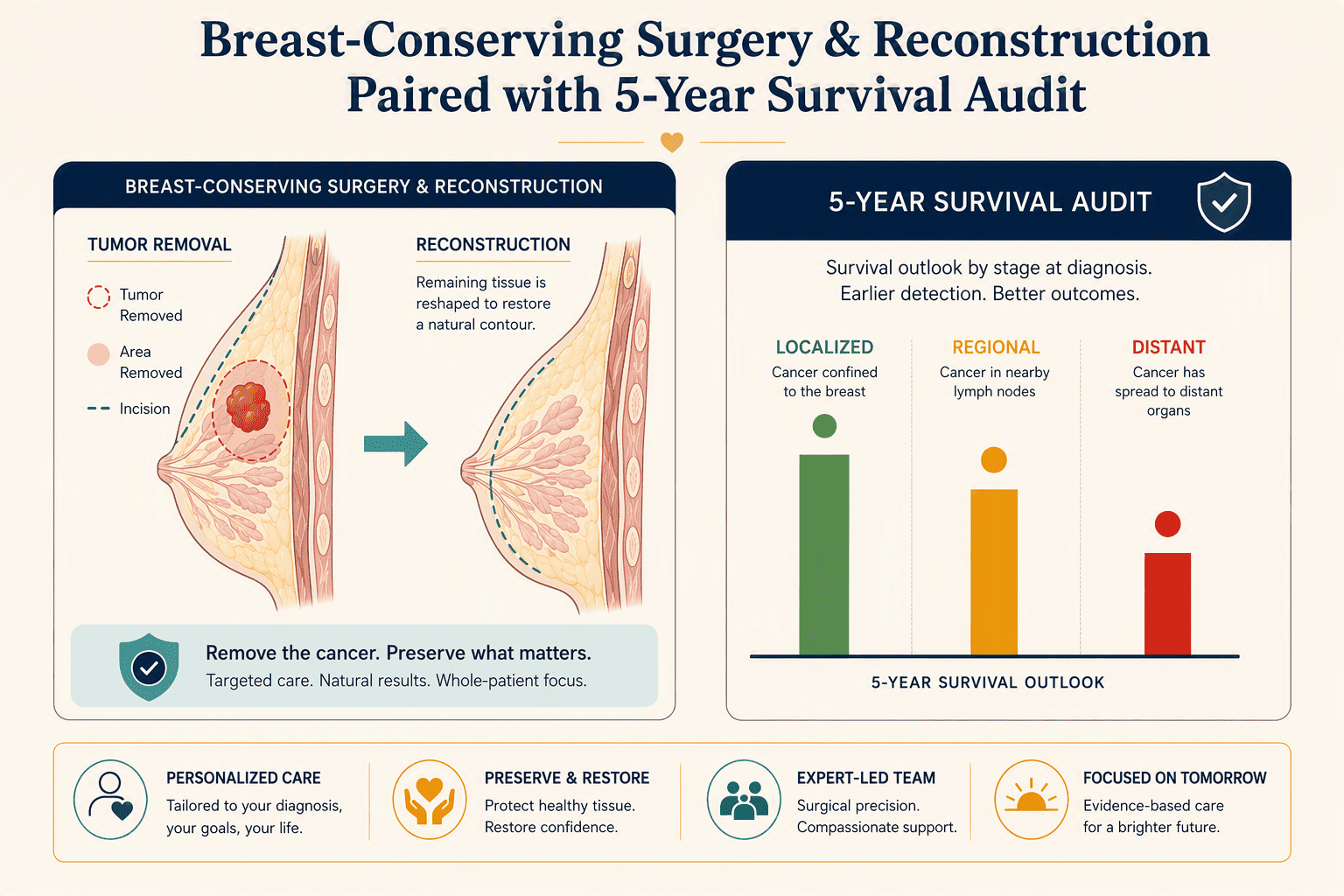
- The stage defines the prognosis and the bill: Localized breast cancer carries a 99.3% 5-year survival rate. Regional spread drops that to 86.3%, and distant metastatic disease stands at 31%. Early detection is the strongest lever on both cost and survival.
1. Andromeda Cancer Hospital, Sonipat
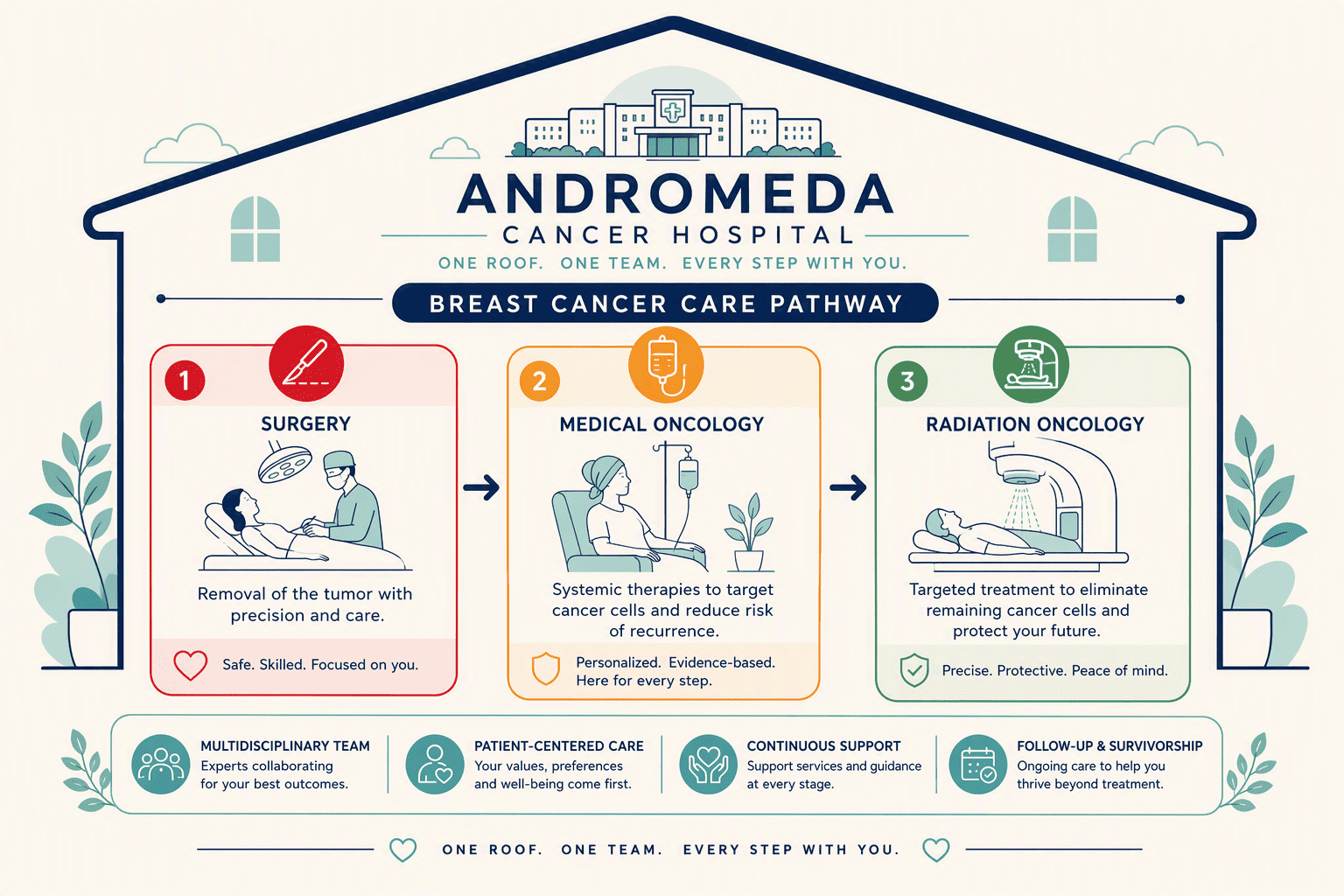
A single-specialty cancer facility changes the cost equation. Andromeda Cancer Hospital in Sonipat runs as a 105-bed dedicated cancer hospital where breast oncology is not a department added on, it is a core pillar. The centre keeps surgical, medical, and radiation oncology under one roof, condensing the multi-visit chaos of fragmented care into a single clinical pipeline. The hospital describes its pricing model as accessible, and for a focused cancer hospital, overheads tied to non-cancer services simply do not exist.
The Andromeda Breast Cancer Centre offers OPD consultation for all breast-related ailments alongside on-site PET-CT imaging. The facility performs oncoplastic resections tailored to body habitus and tumour location, an approach that bridges oncological clearance with cosmetic preservation. On the drug side, the centre provides advanced systemic therapy covering chemotherapy, immunotherapy, targeted therapy, and endocrine therapy. However, patients must note that IHC testing is not yet performed in-house and is outsourced to a partner lab. Diagnostic histopathology reports are stated to be available within 48 to 72 hours.
What you must ask for. Andromeda should be pressed for its own audited 5-year survival data by stage. NABH accreditation status must be confirmed directly. An audit is not a marketing claim; it is a statistical report.
No hospital in this tier can promise what it will not show. Verify before you commit.
2. Post Graduate Institute of Medical Sciences (PGIMS), Rohtak
A government teaching hospital runs on a completely different economic engine. PGIMS Rohtak is a major public tertiary care centre in Haryana, and its budget answers to volume and subsidized access.
Patient volume is high. Treatment protocols follow structured public-sector guidelines. You walk into a system that treats cancer as a standardized clinical challenge rather than a billable event.
Confirm the oncology department's specific infrastructure for breast cancer and the pathway for navigating multi-specialty referrals within the campus. What you save in direct cost, you may spend in waiting time. The system is designed for throughput, and that means queues, scheduled slots that fill early, and consultations that move at the clinician's pace.
Plan your visits around this reality. Haryana's financial assistance schemes do shift the arithmetic for patients who qualify. The Mukhyamantri Muft Ilaaj Yojana (MMIY) covers treatment costs for eligible residents at government hospitals, and the State's Social Justice Department runs a separate programme offering financial assistance for stage III and IV cancer patients.
You need to verify your eligibility and the current fund status when you present at PGIMS, because allocations and covered procedures can change. Public-sector oncology here is not about luxury.
It is about doing the core protocol correctly and affordably. If your priority is keeping out-of-pocket spend as low as possible and you can manage the administrative hustle, PGIMS Rohtak belongs on your shortlist.
3. Paras Hospitals, Gurugram (NCR)
Advanced private care in the NCR comes at a price. Paras Hospitals in Gurugram offers a corporate oncology setup with access to immunohistochemistry for biomarker status. That test is the gatekeeper. It tells you whether targeted therapy for HR-positive or HER2-positive disease is on the table.
A private hospital can move fast. But speed without a cap is a financial hazard. The key defensive move here is to negotiate a fixed-cost package upfront. Without it, your bill can spiral the moment biomarker-driven drug selection enters the picture.
Ask two things before you commit. Does the hospital provide financial counselling or have agreements with medical loan companies? Second, ask if they accept Ayushman Bharat or can route you to a charitable fund. Do not walk in without a price ceiling in writing.
Private-sector oncology in the NCR works hardest for someone with an unusual biomarker profile who needs rapid access to expensive drugs, and who already has the insurance backing or the cash package in hand.
4. Medanta, The Medicity, Gurugram (NCR)
Medanta sits at the top of the cost ladder, and for a reason. Its breast cancer program deploys tumor boards: multidisciplinary teams that plan multimodal therapy in one sitting. Here is what that means for a breast cancer patient.
- Tumour board review standardizes the plan: A surgeon, a medical oncologist, and a radiation oncologist review your scans and biomarker report together. The plan emerges as a single, consensus-driven protocol rather than three overlapping opinions. This reduces contradictory advice and redundant investigations.
- Advanced radiation technology is available on-site: Medanta offers precise radiation delivery systems that spare healthy tissue. This matters particularly for left-sided breast cancers where cardiac exposure must be minimized.
- The cost estimate must be personalized, not generic: Medanta's cost profile is high. Insist on a detailed estimate that breaks down surgery, systemic therapy, and radiation separately. Ask how the stage and biomarker status change the figure. If the estimate does not reflect your specific diagnosis, it is not an estimate; it is a brochure.
- Clinical trials offer an alternative pathway: As a major referral and research centre, Medanta may provide access to trials for specific subtypes, potentially offsetting the cost of novel agents. This is relevant for patients with triple-negative or heavily pre-treated metastatic disease, where survival rates can dip sharply without effective new options.
5. Fortis Memorial Research Institute, Gurugram (NCR)
Fortis Memorial has built a reputation on high-tech oncology. Its breast cancer services include breast-conserving surgery with the kind of sophisticated reconstruction that large corporate chains can fund. But reputation is not the same as a verified outcome.
That is where the demand for audited data becomes non-negotiable. If Fortis claims high success rates, it must produce its own 5-year survival figures, broken down by the stages the NCI uses: localized, regional, distant. A claim without the numbers is a story. An audit with the numbers is a benchmark.
Sophisticated linear accelerators and high-precision surgical tools are only as valuable as the survival curve they produce. Ask for the hospital's own self-audited report before you sign the package. If a hospital cannot show you its data, you cannot evaluate its value.
6. ESIC Medical College & Hospital, Faridabad
The ESIC system creates a defined pathway for insured workers and their dependents that is radically cheaper than any market-rate option. Before you benchmark against this model, understand exactly who it covers.
| Feature | ESIC Beneficiaries | Non-Beneficiary Patients |
|---|---|---|
| Eligibility | Insured workers earning up to a defined wage threshold and their dependents | Open to all, but at standard public or private rates |
| Cancer care cost | Free of charge at the point of care for covered services | Full cost, unless routed through another government scheme |
| Service scope | Surgery, chemotherapy, and radiation as per ESIC formulary | Full hospital tariff applies |
| Financial aid alternative | None needed; costs are pre-paid by the insurance fund | Must explore Ayushman Bharat or the Haryana Health Protection Scheme separately |
For a non-beneficiary, ESIC still serves as a benchmark. It proves that protocol-driven cancer care can be delivered at a fraction of the private-sector cost. If you do not qualify for ESIC, your next move is to check whether you qualify for Ayushman Bharat's ₹5 lakh annual cover or the Haryana Health Protection Scheme at an empaneled facility.
7. Civil Hospital, Panchkula
Civil Hospital Panchkula is your gateway to the state's subsidized oncology system. It is not a thorough cancer centre, but it is the most direct entry point to the government's free care pathway.
Scheme enrollment happens here. This district-level facility is empaneled under the Haryana Health Protection Scheme and Ayushman Bharat. You walk in, establish eligibility, and get routed into a network that can cover cashless treatment across empaneled public and private hospitals for 1,961 procedures spanning medical, surgical, and radiation oncology.
For first-line diagnostics, the hospital provides baseline investigations covered under the Mukhyamantri Muft Ilaaj Yojana, free basic labs, X-ray, ECG, and ultrasound where available. From there, it refers you up the chain to a tertiary oncology unit for definitive treatment.
Patients with Stage III and IV disease can access additional financial support from the state. The Haryana Directorate of Social Justice and Empowerment provides monthly financial assistance or pension statewide, available to all age groups with a family income under Rs. 3 lakh per annum. The scheme stacks on top of any other social security pension you already receive.
8. Max Super Speciality Hospital, Gurugram (NCR)
Max Institute of Cancer Care runs its oncology wing on evidence-based protocols, often aligned with NCCN and NCI guidelines. The multidisciplinary team model means your treatment plan is generated by consensus, not by whichever specialist you happened to book first. This matters when the window between diagnosis and treatment is short and the risk of a fragmented plan is real.
The financial reality of a premier private chain is not hidden. The bill will be significant. Max counters this with a suite of patient financing mechanisms: ties to external medical loan companies and access to charitable funds that can bridge the gap for patients who do not quite qualify for full government aid but cannot pay the sticker price.
Ask directly about these financing channels and the eligibility criteria before any treatment begins. Corporate precision and support services are real. Use them to turn a high-cost estimate into a financed, protocol-driven treatment plan.
Conclusion
Affordable is not a price tag. It is a ratio. A hospital that charges less but delivers substandard outcomes is the most expensive choice you will ever make.
Validate the outcomes through audited 5-year survival data, ask for it broken down by stage and subtype, just as the Tata Memorial Hospital audit does. Validate the affordability not just in the hospital's quoted package, but through the schemes that eliminate cost entirely. Ayushman Bharat's ₹5 lakh annual cover and the Haryana Health Protection Scheme under the Mukhyamantri Muft Ilaaj Yojana are the structural answers to out-of-pocket spending. They work in both public hospitals like Civil Hospital Panchkula and empaneled private centres.
Your job now is to walk into a facility armed with these two questions: what are your audited survival rates, and how do I activate my government coverage here?
Frequently Asked Questions
What is the typical cost range for breast cancer treatment in Haryana, and what factors influence the final price?
There is no single price. Costs swing widely based on three key factors:
- Facility type: public hospitals charge minimal fees, while private NCR centres can run several lakh rupees.
- Cancer stage and biomarker status: HR/HER2 status drives treatment complexity and drug costs.
- Drug regimen: targeted therapy or immunotherapy dramatically increases the bill.
Always request a personalized, line-item estimate tied to your specific diagnosis.
Which hospitals in Haryana offer affordable breast cancer treatment with proven good success rates?
Affordability comes from two routes:
- Government facilities: public hospitals provide low-cost or free care.
- Scheme coverage: Andromeda Cancer Hospital in Sonipat runs a focused, single-specialty model with accessible pricing.
Verify any hospital's claims by demanding audited 5-year survival data broken down by stage, just as the NCI and Tata Memorial audits do.
What treatment modalities for breast cancer are available at an affordable cost in Haryana?
Surgery, including oncoplastic and breast-conserving procedures, chemotherapy, radiation therapy, hormonal therapy, and targeted therapy are all available across Haryana's public and private facilities. Government hospitals and scheme-empaneled centres deliver these modalities at drastically reduced cost. Confirm the hospital can match the modality to your biomarker report.
How do success rates for breast cancer treatment in Haryana compare to national Indian averages?
No published, state-specific registry data isolates Haryana's breast cancer survival rates from the national average. The benchmark is the Tata Memorial Hospital audit. Individual hospitals must provide their own audited data. Clinically, 'success' is defined as 5-year relative survival and disease-free survival, 99.3% for localized disease and 86.3% for regional disease.
Are there financial aid or government schemes to reduce the cost of breast cancer treatment in Haryana?
Yes. Key financial assistance schemes include:
- Ayushman Bharat: offers ₹5 lakh annual cover for eligible families link.
- Mukhyamantri Muft Ilaaj Yojana: covers free diagnostics and surgeries link for state residents.
- Haryana monthly assistance: provides financial help for Stage III and IV cancer patients with an annual family income under Rs. 3 lakh link.
How can a patient verify a hospital's claimed success rates for breast cancer treatment in Haryana?
Ask for two critical documents before committing:
- Audited 5-year survival data: broken down by cancer stage and biomarker subtype.
- NABH accreditation status: confirmed directly from the hospital.
A hospital that cannot produce its own stage-disaggregated audit is asking you to trust its marketing. A hospital that can is showing you the clinical evidence.
Sources
- Breast Oncology | Andromeda - www.andromedahospital.in
- Cancer survival in patients from a hospital-based cancer ... - www.ncbi.nlm.nih.gov
- Breast cancer in a tertiary cancer center in India - pubmed.ncbi.nlm.nih.gov
- Survival Rates and Prognosis for Breast Cancer - NCI - www.cancer.gov
- Financial Assistance for stage III & IV cancer patients | Directorate of Social Justice & Empowerment, Haryana | India - socialjusticehry.gov.in
- Press Release Page | Press Information Bureau - www.pib.gov.in
- Mukhymantri Muft Ilaaj Yojana (MMIY) | Health Department Haryana | India - haryanahealth.gov.in